Physics Books

Blog Archive

Thursday, June 14, 2007

3.45 Magnetic Materials, Spring 2004


Instructor:
Dr. Robert O'Handley


Course Description

This course will cover the following topics:
  • Magnetostatics
  • Origin of magnetism in materials
  • Magnetic domains and domain walls
  • Magnetic anisotropy
  • Reversible and irreversible magnetization processes
  • Hard and soft magnetic materials
  • Magnetic recording

Special topics include magnetism of thin films, surfaces and fine particles; transport in ferromagnets, magnetoresistive sensors, and amorphous magnetic materials.

Materials Science and Engineering 224

Magnetism and Magnetic Materials

Prof. Yuri Suzuki

This course covers the fundamentals of magnetism and magnetic materials in the first two thirds pf the class. Topics include classical versus quantum mechanical pictures, diamagnetism, paramagnetism, crystal field environments, dipolar and exchange interactions, ferrromagnetism, antiferromagnetism, magnetic domains, magnetic anisotropy and magnetostriction. Magnetic materials covered include transition metals, their alloys and pxides, rare earths and their oxides, organic and molecular magnets, etc. Throughout the course, experimental techniques in magnetic characterization will be discussed. The second part of the course will focus on particular magnetic materials and devices that are of technological interest ( e.g., magnetoresistive and magneto-optical materials and devices). Additional topics include biomagnetism and spin glasses.

The purpose of this course is to introduce students to fundamental concepts in magnetism and to apply them to our understanding of magentic materials and devices in the world around us. The coursework assumes knowledge of basic electromagnetism, familiarity with some quantum mechanics and a course either in electronic properties of materials (Mat Sci 111) or an introductory solid state physics course. Through the lectures and readings from the text as well as the literature, students will develop an understanding of basic concepts in magnetism and how to apply them to advanced materials and devices. Materials used in devices for information storage, power and medical applications will be addressed.

This course will meet two times a week for ninety minutes. Students will be required to attend class and submit weekly homework assignments to enforce the fundamental concepts in magnetism. An exam on these fundamental concepts will be given during the semester. In lieu of a final exam, the student will submit a final paper, on a topic of his/her choice related to magnetism, along with a final presentation to the entire class.

TEXTBOOKS and REFERENCES

1. Spaldin, “Magnetic Materials,” REQUIRED TEXT
2. O’Handley, “Modern Magnetic Materials”
3. Cullity, “Introduction to Magnetic Materials” for a classical magnetism reference
4. Chikazumi,”Physics of Magnetism” for a reference with
5. Bozorth, “Ferromagnetism” for a compendium of materials information in addition to fundamental magnetism section
6. Blundell, “Magnetism in Condensed Matter” for a more physics perspective with a good background in quantum mechanics and electromagnetism


Introduction to Magnetism and Magnetic Materials


Second Edition
David C. Jiles Wolfson Centre for Magnetics Technology, Cardiff University

List Price: $66.95
Cat. #: NT1121
ISBN: 9780412798603
ISBN 10: 0412798603
Publication Date: 6/16/1998
Number of Pages: 568


  • Introduces each section with a question that is subsequently answered through the text of the section
  • Reinforces learning with more than 60 sample problems and complete solutions
  • Lists extensive references to principal publications in magnetism at the end of each chapter
  • Covers topics such as magnetic fields, magnetic measurements, magnetic materials, magnetic properties, hard and soft magnetic materials, and magnetic recording
  • Offers an unparalleled assessment of magnetic properties and applications


  • Few subjects in science are more difficult to understand than magnetism, according to Encyclopedia Britannica. However, there is a strong demand today for scientists and engineers with skills in magnetism because of the growing number of technological applications utilizing this phenomenon. This textbook responds to the need for a comprehensive introduction of the basic concepts of the science.

    Introduction to Magnetism and Magnetic Materials has been thoroughly revised since the first edition to include recent developments in the field. The early chapters comprise a discussion of the fundamentals of magnetism. These chapters include more than 60 sample problems with complete solutions to reinforce learning. The later chapters review the most significant recent developments in four important areas of magnetism: hard and soft magnetic materials, magnetic recording, and magnetic evaluation of materials. These later chapters also provide a survey of the most important areas of magnetic materials for practical applications. Extensive references to the principal publications in magnetism are listed at the end of each chapter, which offer the reader rapid access to more specialized literature.

    Students in various scientific areas will benefit from this book, including those in physics, materials science, metallurgy, and electrical engineering.


    Table of Contents
    PART 1: ELECTROMAGNETISM - MAGNETIC PHENOMENA ON THEMACROSCOPIC SCALE

    MAGNETIC FIELDS
    The Magnetic Field
    Magnetic Induction
    Magnetic Field Calculations
    References
    Further Reading
    Exercises

    MAGNETIZATION AND MAGNETIC MOMENT
    Magnetic Moment
    Magnetic Poles and Amperian Bound Currents
    Magnetization
    Magnetic Circuits and Demagnetizing Field
    Penetration of Alternating Magnetic Fields into Materials
    References
    Further Reading
    Exercises

    MAGNETIC MEASUREMENTS
    Induction Methods
    Force Methods
    Methods Depending on Changes in Material Properties
    SQUIDS
    References
    Further Reading
    Exercises

    MAGNETIC MATERIALS
    Classification of Magnetic Materials
    Magnetic Properties of Ferromagnets
    Different Types of Ferromagnetic Materials for Applications
    Paramagnetism and Diamagnetism
    References
    Further Reading
    Exercises

    MAGNETIC PROPERTIES
    Hysteresis and Related Properties
    The Barkhausen Effect and Related Phenomena
    Magnetostriction
    Magnetoresistance
    References
    Further Reading
    Exercises

    PART 2: MAGNETISM IN MATERIALS - MAGNETIC PHENOMENA ON THE MICROSCOPIC SCALE

    MAGNETIC DOMAINS
    Development of Domain Theory
    Energy Considerations and Domain Patterns
    References
    Further Reading
    Exercises

    DOMAIN WALLS
    Properties of Domain Boundaries
    Domain-wall Motion
    References
    Further Reading
    Exercises

    DOMAIN PROCESSES
    Reversible and Irreversible Domain Processes
    Determination of Magnetization Curves from Pinning Models
    Theory of Ferromagnetic Hysteresis
    Dynamics of Domain Magnetization Processes
    References
    Further Reading
    Exercises

    MAGNETIC ORDER AND CRITICAL PHENOMENA
    Theories of Paramagnetism and Diamagnetism
    Theories of Ordered Magnetism
    Magnetic Structure
    References
    Further Reading
    Exercises

    ELECTRONIC MAGNETIC MOMENTS
    Classical Model of Magnetic Moments of Electrons
    Quantum Mechanical Model of Magnetic Moments of Electrons
    Magnetic Properties of Free Atoms
    References
    Further Reading
    Exercises

    QUANTUM THEORY OF MAGNETISM
    Electron-electron Interactions
    The Localized Electron Theory
    The Itinerant Electron Theory
    References
    Further Reading
    Exercises


    PART 3: MAGNETICWS - TECHNOLOGICAL APPLICATIONS

    SOFT MAGNETIC MATERIALS
    Properties and Applications
    Materials for AC Applications
    Materials for DC Applications
    Materials for Magnetic Shielding
    References
    Further Reading

    HARD MAGNETIC MATERIALS
    Properties and Applications
    Permanent Magnet Materials
    References
    Further Reading

    MAGNETIC RECORDING
    Magnetic Recording Media
    Recording Heads and the Recording Process
    Modeling the Magnetic Recording Process
    References
    Further Reading

    MAGNETIC EVALUATION OF MATERIALS
    Methods for Evalulation of Intrinsic Properties
    Methods for Detection of Flaws and Other Inhomogeneities
    Magnetic Imaging Methods
    Conclusions
    References
    Further Reading

    SOLUTIONS
    APPENDICES
    AUTHOR INDEX
    SUBJECT INDEX


    Physics of Ferromagnetism

    Physics of Ferromagnetism

    Second Edition

    Soshin Chikazumi

    Translation editor: C. D. Graham

    Price: £165.00 (Hardback)
    ISBN-10: 0-19-851776-9
    ISBN-13: 978-0-19-851776-4
    Publication date: 27 February 1997
    Clarendon Press
    668 pages, halftones, numerous line figures, tables, 240x168 mm
    Series: International Series of Monographs on Physics number 94

    Description

    • · Includes recent developments and techniques in magnetics
    • · Describes magnetic phenomena intuitively and comprehensively


    Readership: Graduate students and researchers in magnetism including departments of physics, materials science and materials engineering.

    Contents
    1. Magnetostatic phenomena
    2. Magnetic measurements
    3. Atomic magnetic moments
    4. Macroscopic experimental techniques
    5. Magnetic disorder
    6. Ferromagnetism
    7. Antiferromagnetism and ferrimagnetism
    8. Magnetism of metals and alloys
    9. Magnetism of ferromagnetic oxides
    10. Magnetism of compounds
    11. Magnetism of amorphous materials
    12. Magnetocrystalline anisotrophy
    13. Induced magnetic anisotropy
    14. Magnetostriction
    15. Observation of domain structures
    16. Spin distribution and domain walls
    17. Magnetic domain structure
    18. Technical magnetization
    19. Spin phase transition
    20. Dynamic magnetization
    21. Various phenomena association with magnetization
    22. Engineering applications of magnetic materials

    Authors, editors, and contributors


    Soshin Chikazumi, Professor Emeritus, University of Tokyo
    Translation editor: C. D. Graham, Professor Emeritus, University of Pennsylvania

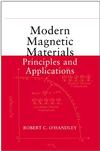
    Modern Magnetic Materials: Principles and Applications


    Modern Magnetic Materials: Principles and Applications
    ISBN: 978-0-471-15566-9
    Hardcover
    768 pages
    November 1999

    Table Of Contents

    Introduction and Overview.

    Magnetostatics.

    Classical and Quantum Phenomenology of Magnetism.

    Quantum Mechanics, Magnetism, and Exchange in Atoms and Oxides.

    Quantum Mechanics, Magnetism, and Bonding in Metals.

    Magnetic Anisotropy.

    Magnetoelastic Effects.

    Magnetic Domain Walls and Domains.

    Magnetization Process.

    Soft Magnetic Materials.

    Amorphous Materials: Magnetism and Disorder.

    Magnetism in Small Structures: Exchange Coupling and Nanocrystals.

    Hard Magnetic Materials.

    Magnetic Annealing and Directional Order.

    Electronic Transport in Magnetic Materials.

    Surface and Thin-Film Magnetism.

    Magnetic Recording.

    Appendices.

    Index.


    Tuesday, September 26, 2006

    Workshop Physics

    http://physics.dickinson.edu/~wp_web/wp_homepage.html

    Workshop Physics is one component of the Activity Based Physics Suite. It is a calculus-based introductory physics curriculum designed to completely replace traditional lectures and laboratories. In a typical two-hour Workshop Physics class session, students use equipment and computer tools for data acquisition, visualization, analysis, and mathematical modeling.

    Activity Based Physics

    http://physics.dickinson.edu/~abp_web/abp_homepage.html

    Activity-Based Physics is a multi-institutional project to sustain and enhance current efforts to render introductory physics courses more effective and exciting at both the secondary and college level. This program represents a collaborative effort by an informally constituted team of educational reformers to use the outcomes of physics education research along with flexible computer tools to develop activity-based models of physics instruction. This project includes the refinement of existing written materials, apparatus, instructional techniques, and computer software and hardware; the creation of new instructional materials and approaches; as well as classroom testing in different settings and dissemination. The refinement and development of instructional strategies and materials is informed by a comprehensive program of educational research.

    Tuesday, September 05, 2006

    Six Ideas That Shaped Physics: Unit C: Conservation Laws Constrain Interactions, 2E

    http://catalogs.mhhe.com/mhhe/viewProductDetails.do?isbn=0072291524

    Six Ideas That Shaped Physics: Unit C: Conservation Laws Constrain Interactions, 2nd Edition


    Thomas A Moore, POMONA COLLEGE
    Softcover, 306 pages
    ©2003, ISBN 0072291524


    Table of Contents


    C1 Introduction to Interactions

    C2 Vectors

    C3 Interactions Transfer Momentum

    C4 Particles and Systems

    C5 Applying Momentum Conservation

    C6 Introduction to Energy

    C7 Some Potential Energy Functions

    C8 Force and Energy

    C9 Rotational Energy

    C10 Thermal Energy

    C11 Energy in Bonds

    C12 Power, Collisions, and Impacts

    C13 Angular Momentum

    C14 Conservation of Angular Momentum

    Six Ideas that Shape Physics - Moore , 2E

    http://catalogs.mhhe.com/mhhe/viewProductDetails.do?isbn=0072564822


    Six Ideas that Shape Physics: 6 Unit package, 2nd Edition


    Thomas A Moore, POMONA COLLEGE

    ©2003, ISBN 0072564822


    Description


    SIX IDEAS THAT SHAPED PHYSICS is the 21st century's alternative to traditional, encyclopedic textbooks. Thomas Moore designed SIX IDEAS to teach students: --to apply basic physical principles to realistic situations --to solve realistic problems --to resolve contradictions between their preconceptions and the laws of physics --to organize the ideas of physics into an integrated hierarchy


    Features


    • A MORE CAREFUL AND COMPREHENSIVE APPROACH TO PROBLEM-SOLVING FRAMEWORKS. This includes a new general problem-solving framework that applies across units, new tools for solving specific kinds of problems, and more general instruction in problem-solving in the text.

    • A NEW APPROACH TO EMPHASIZING IMPORTANT FORMULAS. The new edition puts crucial formulas in boxes that also display important information about its purpose and limitations and what its symbols mean.

    • MANY MORE PHOTOGRAPHS help make the text more visually interesting and help link the concepts to physical reality.

    • TWO-COLOR LAYOUT WITH COLOR TIED TO PEDAGOGICAL GOALS. Color is used to emphasize the imaginary elements we add to a situation when we construct a mental model.

    • UNIT E (Electromagnetic Fields) HAS BEEN REWRITTEN to reduce the level of the mathematics, more strongly emphasize the concept of potential, and more strongly emphasize visual arguments.

    • UNIT C (Conservation Laws) HAS BEEN REORGANIZED to increase the time spent on the difficult topics of collisions and angular momentum, to introduce the concept of force sooner, and to present the material in a more efficient manner.

    • UNIT N (Laws of Physics) HAS BEEN SIMPLIFIED to reduce the level of the mathematics in various chapters, to use more visually-based lines of reasoning, and to more strongly emphasize computer solutions to realistic problems.

    • NEW MATERIAL IN UNIT T (Thermodynamics, gases...) includes a treatment of the Boltzmann Factor and a more realistic exploration of degrees of freedom in gas molecules. This unit also discusses several new computer programs that help students more easily visualize important ideas.

    The Sciences: An Integrated Approach - Trefil, 5E

    http://www.wiley.com/WileyCDA/WileyTitle/productCd-0471769924.html

    The Sciences: An Integrated Approach, 5th Edition
    James Trefil
    ISBN: 0-471-76992-4
    Paperback
    624 pages
    October 2006

    This product is not currently available for purchase from this website.


    Description
    The Sciences, 5th Edition integrates major concepts from physics, chemistry, astronomy, earth sciences, and biology to help anyone become science-literate. Even readers with little or no science background will find this unique book an indispensable guide to understanding the latest headlines, controversies, and scientific developments. The new edition keeps pace with the dynamic nature of the sciences by incorporating the most up-to-date discoveries in all five disciplines.

    Table of Contents
    Table of Contents

    Preface

    Science: A Way of Knowing

    The Ordered Universe

    Energy

    Heat And The Second Law Of Thermodynamics

    Electricity and Magnetism

    Waves And Electromagnetic Radiation

    Albert Einstein And The Theory of Relativity

    The Atom

    Quantum Mechanics

    Atoms In Combination: The Chemical Bond

    Materials and their Properties

    The Nucleus Of The Atom

    The Ultimate Structure Of Matter

    The Stars

    Cosmology

    The Earth And Other Planets

    Plate Tectonics

    Earth’s Many Cycles

    Ecology, Ecosystems, And The Environment

    Strategies Of Life

    The Living Cell

    Molecules of Life

    Classical And Modern Genetics

    The New Science Of Life

    Evolution

    Appendices

    Human Anatomy

    Units And Numbers

    The Geologic Time Scale

    Selected Physical Constants And Astronomical Data

    Properties Of The Planets

    The Chemical Element

    Glossary

    Credits

    Index

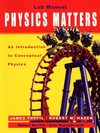
    Physics Matters: An Introduction to Conceptual Physics, Laboratory Manual - Trefil

    http://www.wiley.com/WileyCDA/WileyTitle/productCd-0471261548,descCd-description.html

    Laboratory Manual to Accompany Physics Matters: An Introduction to Conceptual Physics
    James Trefil, Robert M. Hazen, Robert Ehrlich, Ania Wyczalkowski
    ISBN: 0-471-26154-8
    Paperback
    166 pages
    June 2004
    US $21.95 This price is valid for Colombia.
    Description
    Get hands-on experience with this Lab Manual! Designed to accompany Trefil’s Physics Matters, this Lab Manual contains 20 different labs covering major topics with common equipment.

    Written by authors who have vast experience in communicating science to general audiences, Physics Matters conveys the principles of physics in a manner that is understandable to the non-scientist. In a prose style that is clear, engaging, and contemporary, it pays particular attention to the relevance of physics in comprehending our modern technological society and the issues created by those technologies.


    Table of Contents
    Experiment One. Perception; Making Estimates and Measurement; Units.

    Experiment Two. Motion at Constant Velocity.

    Experiment Three. Motion at Constant Acceleration.

    Experiment Four. Forces- 1 Dimension.

    Experiment Five. Forces in 2-Dimensions.

    Experiment Six. Momentum Conservation.

    Experiment Seven. Torques.

    Experiment Eight. Work and Energy Conservation.

    Experiment Nine. Archimedes’ Principle.

    Experiment Ten. Radiant Heating and Cooling.

    Experiment Eleven. Simple Harmonic Motion.

    Experiment Twelve. Waves.

    Experiment Thirteen. Ohm’s Law and Electric Circuit Part 1.

    Experiment Fourteen. Electric Circuits Part 2, RC Decay.

    Experiment Fifteen. Magnetic Fields.

    Experiment Sixteen. Induction and Transformers.

    Experiment Seventeen. Reflection, Refraction, and Polarization of Light.

    Experiment Eighteen. Mirrors and Lenses.

    Experiment Nineteen. Atomic Spectra.

    Experiment Twenty. Nuclear Decay Simulation.

    Index.

    Physics Matters: An Introduction to Conceptual Physics, Activity Book - Trefil

    http://www.wiley.com/WileyCDA/WileyTitle/productCd-0471428981.html

    Physics Matters: An Introduction to Conceptual Physics, Activity Book
    James Trefil, Robert M. Hazen
    ISBN: 0-471-42898-1
    Paperback
    178 pages
    February 2004
    US $21.95 This price is valid for Colombia.

    Physics Matters: An Introduction to Conceptual Physics, Trefil

    http://www.wiley.com/WileyCDA/WileyTitle/productCd-0471150584,descCd-description.html

    Physics Matters: An Introduction to Conceptual Physics
    James Trefil, Robert M. Hazen
    ISBN: 0-471-15058-4
    Hardcover
    691 pages
    January 2004
    US $77.95 This price is valid for Colombia.

    Description
    From amusement park rides to critical environmental issues such as energy generation-physics affects almost every aspect of our world. In PHYSICS MATTERS, James Trefil and Robert Hazen examine the fundamental physics principles at work behind the many practical applications that fuel our society and individual lives. Their goal is to promote a deeper understanding of how the great ideas of physics connect to form a much larger understanding of the universe in which we live.

    Highlights

    • Helps readers build a general knowledge of key ideas in physics and their connection to technology and other areas of science.
    • Promotes an appreciation of what science is, how scientific knowledge is developed, and how it differs from other intellectual activities.
    • Examines modern technologies, including GPS, the Internet, and information technologies, as well as medical technologies, such as MRI, PET scans, CAT scans, and radioisotope tracers.
    • Explores key issues facing the world today, such as global warning, nuclear waste, and government funding for research.

    Table of Contents
    PART I. INTRODUCTION.

    1. Science: A Way of Knowing.

    2. The Language of Science.

    PART II. MECHANICS AND ENERGY.

    3. Motions in the Universe.

    4. Isaac Newton and the Laws of Motion.

    5. The Law of Universal Gravitation.

    6. Conservation of Linear Momentum.

    7. Rotational Motion of an Object.

    8. Kinetic and Potential Energy.

    PART III. MATTER, ENERGY, AND THE LAWS OF THERMODYNAMICS.

    9. Atomic Structure and Phases of Matter.

    10. Properties of Matter.

    11. Heat and Temperature.

    12. The First Law of Thermodynamics.

    13. Entropy and the Second Law of Thermodynamics.

    PART IV. WAVES.

    14. Vibrations and Waves.

    15. Sound.

    PART V. ELECTRICITY AND MAGNETISM.

    16. Electric and Magnetic Forces.

    17. Electromagnetic Interactions.

    18. Electric Circuits.

    19. The Electromagnet ic Spectrum.

    20. Classical and Modern Optics.

    PART VI. THE ATOM.

    21. Atomic Structure and Interactions.

    22. Quantum Mechanics.

    23. Chemical Bonds and Physical Properties.

    24. Electrical and Magnetic Properties of Materials.

    25. Semiconductor Devices and Information Technology.

    PART VII. THE NUCLEUS AND ELEMENTARY PARTICLES.

    26. The Nucleus of The Atom.

    27. The Ultimate Structure of Matter.

    PART VIII. RELATIVITY AND COSMOLOGY.

    28. Albert Einstein and the Theory of Relativity.

    29. Cosmology.

    Appendix A: Units and Numbers.

    Appendix B: Selected Physical Constants.

    Appendix C: Periodic Table and Atomic Weights.

    Glossary.

    Photo Credits.

    Index.


    Author Information
    James Trefil is the Clarence J. Robinson Professor of Physics at George Mason University. He has made contributions to research in elementary particle physics, fluid mechanics, medical physics (including cancer research), and the earth sciences and has written extensively about science for the general audience. He has recently completed a term as General Councilor of the American Physical Society and was awarded the prestigious Gemant Prize of the American Institute of Physics for his efforts to present science to the general public.

    Robert M. Hazen is the Clarence J. Robinson Professor of Earth Science at George Mason University and Staff Scientist at the Carnegie Institution of Washington Geophysical Laboratory. He performs research on materials at high pressure and is studying the hypothesis that life arose in a deep, high-pressure environment. He is the author of more than 230 articles and 16 books on science, history, and music. A Fellow of the American Association for the Advancement of Science, he has received numerous awards for his science writing.

    Teaching Introductory Physics, Homework & Test Questions, Arons

    http://www.wiley.com/WileyCDA/WileyTitle/productCd-0471309311.html

    Homework and Test Questions for Introductory Physics Teaching
    Arnold B. Arons
    ISBN: 0-471-30931-1
    Paperback
    279 pages
    February 1994
    US $53.95 This price is valid for Colombia.

    This is a Print-on-Demand title. It will be printed specifically to fill your order. Please allow an additional 3 days delivery time for paperbacks, and 10 days for hardcovers. The book is not returnable.

    Description
    This collection is confined to an extremely fundamental level of subject matter common to the great majority of introductory physics courses. Questions range from simple to fairly sophisticated, extending over a variety of modes that emerge as essential components in the learning and understanding of physics. These modes include forming and applying basic concepts, operational definition, verbalization, connection of abstractions to everyday experience, checking for internal consistency and interpreting results.

    Table of Contents
    Scaling and Ratio Reasoning.

    Kinematics.

    Force and Dynamics.

    Momentum and Energy.

    Electricity.

    Direct Current Circuits.

    Electromagnetism.

    Particle Trajectories in E- and B-Fields.

    Wave Phenomena.

    Images with Mirrors and Lenses.

    Geometrical and Physical Optics.

    Fluids and Thermal Phenomena.

    Kinetic Theory.

    Modern Physics.

    Mixed Areas of Subject Matter.

    Naked Eye Astronomy.

    Learning Objectives.

    Term Paper Assignments.

    Teaching Introductory Physics - Arons

    http://www.wiley.com/WileyCDA/WileyTitle/productCd-0471137073,descCd-description.html

    Teaching Introductory Physics
    Arnold B. Arons
    ISBN: 0-471-13707-3
    Paperback
    816 pages
    August 1996
    US $83.95 This price is valid for Colombia.

    This is a Print-on-Demand title. It will be printed specifically to fill your order. Please allow an additional 3 days delivery time for paperbacks, and 10 days for hardcovers. The book is not returnable.

    Description
    This book is an invaluable resource for physics teachers. It contains an updated version of the author's A Guide to Introductory Physics Teaching (1990), Homework and Test Questions (1994), and a previously unpublished monograph "Introduction to Classical Conservation Laws".

    Table of Contents
    Partial table of contents:

    Underpinnings.

    Rectilinear Kinematics.

    Elementary Dynamics.

    Motion in Two Dimensions.

    Momentum and Energy.

    Static Electricity.

    Current Electricity.

    Electromagnetism.

    Waves and Light.

    Early Modern Physics.

    Miscellaneous Topics.

    Achieving Wider Scientific Literacy.

    Critical Thinking.

    Bibliography.

    Index.

    How Things Work: The Physics of Everyday Life - Bloomfield, 3E

    http://www.wiley.com/WileyCDA/WileyTitle/productCd-047146886X.html

    How Things Work: The Physics of Everyday Life, 3rd Edition
    Louis A. Bloomfield
    ISBN: 0-471-46886-X
    Paperback
    576 pages
    October 2005
    US $68.95 This price is valid for Colombia.
    Description
    This book is an unconventional introduction to physics and science that starts with whole objects and looks inside them to see what makes them work. It's written for students who seek a connection between science and the world in which they live. How Things Work brings science to the reader rather than the reverse. Like the course in which it developed, this book has always been for nonscientists and is written with their interests in mind. Nonetheless, it has attracted students from the sciences, engineering, architecture, and other technical fields who wish to put scientific concepts into context.

    This book is written in English and organized in a case-study fashion. It conveys an understanding and appreciation for physics by finding physics concepts and principles within the familiar objects of everyday experience. Because its structure is defined by real-life examples, this book necessarily discusses concepts as they're needed and then revisits them later on when they reappear in other objects.

    Lou Bloomfield is a highly dedicated teacher and one of the most popular professors at University of Virginia, and was the recipient of the 1998 State of Virginia Outstanding Faculty Award. Lou has given talks all over the country on teaching physics through everyday objects. He has extreme attention to detail and knowledge of technical physics. He is very tech savvy and has been able to provide many of the photos and illustrations for the text himself.

    Table of Contents
    Chapter 1. The Laws of Motion, Part I.
    Experiment: Removing a Tablecloth from a Table 1.

    1.1 Skating.
    (inertia, force, velocity, acceleration, mass, Newton's first and second laws, inertial frames of reference, units).

    1.2 Falling Balls.
    (weight, projectile motion, vector components).

    1.3 Ramps.
    (net force, Newton's third law, energy, work, energy conservation, potential energy, ramps,mechanical advantage).

    Chapter 2. The Laws of Motion, Part II.
    Experiment: A Spinning Pie Dish.

    2.1 Seesaws.
    (rotational inertia, torque, angular velocity, angular acceleration, rotational mass, Newton's first and second laws of rotation, center of mass, levers).

    2.2 Wheels.
    (friction, thermal energy, wheels, bearings, kinetic energy).

    2.3 Bumper Cars.
    (momentum, impulse, momentum conservation, angular momentum, angular impulse, angular momentum conservation, Newton’s third law of rotation, potential energy and acceleration).

    Chapter 3. Mechanical Objects, Part I.
    Experiment: Swinging Water Overhead.

    3.1 Spring Scales.
    (Equilibrium, stable equilibrium, Hooke’s law, oscillation, calibration, center of gravity).

    3.2 Bouncing Balls.
    (collisions, energy transfers, vibration, elastic and inelastic collisions).

    3.3 Carousels and Roller Coasters.
    (feeling of acceleration, uniform circular motion, centripetal acceleration).

    Chapter 4. Mechanical Objects, Part II.
    Experiment: High Flying Balls.

    4.1 Bicycles.
    (unstable equilibrium, static and dynamic stability, precession).

    4.2 Rockets and Space Travel.
    (reaction forces, Newton's law of gravitation, elliptical orbits, Kepler’s laws, special and general relativity, equivalence principle).

    Chapter 5. Fluids.
    Experiment: A Cartesian Diver.

    5.1 Balloons.
    (pressure, density, temperature, Archimedes’ principle, buoyant force, ideal gas law).

    5.2 Water Distribution.
    (hydrostatics, Pascal’s principle, hydraulics, hydrodynamics, steady state flow, Bernoulli’s equation).

    Chapter 6. Fluids and Motion.
    Experiment: A Vortex Cannon.

    6.1 Garden Watering.
    (viscous forces, laminar and turbulent flows, speed and pressure in a fluid, Reynolds number, chaos, momentum in a fluid).

    6.2 Balls and Air.
    (aerodynamic lift and drag, viscous drag, pressure drag, boundary layers, Magnus and wake deflection forces).

    6.3 Airplanes.
    (streamlining, lifting wing, angle of attack, induced drag, stalled wing, thrust).

    Chapter 7. Heat and Phase Transitions.
    Experiment: A Ruler Thermometer.

    7.1 Woodstoves.
    (thermal energy, heat, temperature, chemical bonds and reactions, conduction, thermal
    conductivity, convection, radiation, heat capacity).

    7.2 Water, Steam, and Ice.
    (phases of matter, phase transitions, melting, freezing, condensation, evaporation, relative humidity, latent heats of melting and evporation, sublimation, deposition, boiling, nucleation, superheating).

    7.3 Incandescent Lightbulbs.
    (electromagnetic spectrum, light, blackbody spectrum, emissivity, Stefan-Boltzmann law, thermal expansion).

    Chapter 8. Thermodynamics.
    Experiment: Making Fog in a Bottle.

    8.1 Air Conditioners.
    (laws of thermodynamics, temperature, heat, entropy, heat pumps and thermodynamic efficiency).

    8.2 Automobiles.
    (heat engines and thermodynamic efficiency).

    Chapter 9. Resonance and Mechanical Waves.
    Experiment: A Singing Wineglass.

    9.1 Clocks.
    (time and space, natural resonance, harmonic oscillators, simple harmonic motion, frequency).

    9.2 Musical Instruments.
    (sound, music, vibrations in strings, air, and surfaces, higher-order modes, harmonic and nonharmonic overtones, sympathetic vibration, standing and traveling waves, transverse and longitudinal waves, velocity, frequency, and wavelength in mechanical waves, superposition, Doppler effect).

    9.3 The Sea.
    (tidal forces, surface waves, dispersion, refraction, reflection, and interference in mechanical waves).

    Chapter 10. Electricity.
    Experiment: Moving Water Without Touching It.

    10.1 Static Electricity.
    (electric charge, electrostatic forces, Coulomb’s law, electrostatic potential energy, voltage, charging by contact, electric polarization, electrical conductors and insulators).

    10.2 Xerographic Copiers.
    (electric fields and voltage gradients, relationships between shape and field, discharges, electric current, direction of current flow, charging by induction).

    10.3 Flashlights.
    (electric circuits, electrical resistance, voltage rises, voltage drops, relationship between current, voltage, and power, Ohm’s law).

    Chapter 11. Magnetism and Electrodynamics.
    Experiment: A Nail and Wire Electromagnet.

    11.1 Household Magnets.
    (magnetic pole, magnetostatic forces, Coulomb’s law for magnetism, magnetic fields, ferromagnetism, magnetic polarization, magnetic domains, magnetic materials, magnetic flux lines, relationship between currents and magnetic fields).

    11.2 Electric Power Distribution.
    (superconductivity, direct and alternating currents, induction, transformers, magnetic field energy, relationship between changing magnetic fields and electric fields, induced emf, Lenz’s law, electrical safety).

    11.3 Electric Generators and Motors.
    (electromagnetic forces, energy, and work, Lorenz force).

    Chapter 12. Electronics.
    Experiment: Building an Electronic Kit.

    12.1 Power Adapters.
    (quantum physics, wave-particle duality, Pauli exclusion principle, band structure, Fermi level, metals, insulators, and semiconductors, p-n junction, diodes, capacitors).

    12.2 Audio Players.
    (analog vs. digital representations, resistors, MOSFETs, logic elements, series and parallel circuits, amplifiers).

    Chapter 13. Electromagnetic Waves.
    Experiment: Boiling Water in an Ice Cup.

    13.1 Radio.
    (electric field energy, relationship between changing electric fields and magnetic fields, tank circuits, speed of light, wave polarization, amplitude modulation, frequency modulation, bandwidth).

    13.2 Microwave Ovens.
    (speed, frequency, and wavelength in electromagnetic waves, polar and nonpolar molecules, cyclotron motion).

    Chapter 14. Light.
    Experiment: Splitting the Colors of Sunlight.

    14.1 Sunlight.
    (Rayleigh scattering, impedance, refraction, reflection, dispersion, and interference in electromagnetic waves, index of refraction, polarized reflection).

    14.2 Discharge Lamps.
    (color vision, primary colors of light and pigment, gas discharges, periodic chart, atomic structure and emission, radiative transitions, Planck’s constant, fluorescence, radiation trapping).

    14.3 Lasers and LEDs.
    (incoherent and coherent light, spontaneous and stimulated emission, population inversion, laser amplification and oscillation, diffraction, laser safety).

    Chapter 15. Optics.
    Experiment: Focusing Sunlight.

    15.1 Cameras.
    (refracting optics, converging lenses, real images, focus, focal lengths, f-numbers, the lens equation, diverging lenses, virtual images, light sensors, vision and vision correction).

    15.2 Optical Recording and Communication.
    (diffraction limit, plane and circular polarization, total internal reflection).

    Chapter 16. Modern Physics.
    Experiment: Radiation Damaged Paper.

    16.1 Nuclear Weapons.
    (nuclear structure, isotopes, radioactivity, uncertainty principle, tunneling, half-life, alpha decay, fission, chain reaction, fusion, transmutation of elements, fallout).

    16.2 Medical Imaging and Radiation.
    (X rays, gamma rays, X-ray fluorescence, Bremsstrahlung, photoelectric effect, Compton scattering, beta decay, anitimatter, accelerators, magnetic resonance).

    Appendices.

    A. Vectors.

    B. Units, Conversion of Units.

    Glossary.

    Solutions to Selected Exercises and Problems.

    Index.


    Author Information
    Lou Bloomfield is a highly dedicated teacher and one of the most popular professors at University of Virginia, and was the recipient of the 1998 State of Virginia Outstanding Faculty Award. Lou has given talks all over the country on teaching physics through everyday objects. He has extreme attention to detail and knowledge of technical physics. He is very tech savvy and has been able to provide many of the photos and illustrations for the text himself.

    Interactive Lecture Demonstrations - Sokoloff

    http://www.wiley.com/WileyCDA/WileyTitle/productCd-0471487740.html

    Interactive Lecture Demonstrations
    David R. Sokoloff, Ronald K. Thornton
    ISBN: 0-471-48774-0
    Paperback
    374 pages
    September 2006
    US $29.95 This price is valid for Colombia.

    This is a Print-on-Demand title. It will be printed specifically to fill your order. Please allow an additional 3 days delivery time for paperbacks, and 10 days for hardcovers. The book is not returnable.


    Description
    Interactive Lecture Demonstrations (ILDs) are designed to enhance conceptual learning in physics lectures through active engagement of students in the learning process. Students observe real physics demonstrations, make predictions about the outcomes on a prediction sheet, and collaborate with fellow students by discussing their predictions in small groups. Students then examine the results of the live demonstration (often displayed as real-time graphs using computer data acquisition tools), compare these results with their predictions, and attempt to explain the observed phenomena. ILDs are available for all of the major topics in the introductory physics course and can be used within the traditional structure of an introductory physics course. All of the printed materials needed to implement them are included in this book.

    Table of Contents
    Section I: Introduction to Interactive Lecture Demonstrations
    The Eight Step Interactive Lecture Demonstration Procedure

    Section II: Interactive Lecture Demonstrations in Mechanics
    KIN1 Kinematics 1—Human Motion
    KIN2 Kinematics 2—Motion of Carts
    N1&2 Newton’s 1st & 2nd Laws
    N3 Newton’s 3rd Law
    VECT Vectors
    PROJ Projectile Motion
    ENER Energy of a Cart on a Ramp
    MOM Momentum
    ROTM Rotational Motion
    STAT Statics
    FLUS Fluid Statics

    Section III: Interactive Lecture Demonstrations in Oscillations and Waves
    SHM Simple Harmonic Motion
    SND Sound

    Section IV: Interactive Lecture Demonstrations in Heat and Thermodynamics
    INHT Introduction to Heat and Temperature
    SPHT Specific Heat
    HTPC Heat and Phase Changes
    HENG Heat Engine

    Section V: Interactive Lecture Demonstrations in Electricity and Magnetism
    EFFP Electrostatic Field, Force and Potential
    INDC Introduction to DC Circuits
    SPC Series and Parallel Circuits
    RCC RC Circuits
    MAG Magnetism
    EMIN Electromagnetic Induction
    ACC AC Circuits

    Section VI: Interactive Lecture Demonstrations in Light and Optics
    RRLT Reflection and Refraction of Light
    IMFL Image Formation with Lenses
    MIRR Mirrors
    POL Polarized Light

    Appendix A: Interactive Lecture Demonstration Experiment Configuration Files

    Matter & Interactions II: Electric & Magnetic Interactions, Version 1.2

    http://www.wiley.com/WileyCDA/WileyTitle/productCd-0471663271.html

    Matter & Interactionss II: Electric & Magnetic Interactions, Version 1.2
    Ruth W. Chabay, Bruce A. Sherwood
    ISBN: 0-471-66327-1
    Paperback
    528 pages
    December 2003
    US $87.95 This price is valid for Colombia.

    Description
    · Atomic nature of matter is unifying theme

    · Emphasis on constructing and using physical models

    · Teaches computer modeling

    · Use of desktop experiments to build physical intuition

    Table of Contents

    VOLUME II. ELECTRIC & MAGNETIC INTERACTIONS.

    Chapter 13. Electric Field.

    Chapter 14. Matter and Electric Fields.

    Chapter 15. Electric Field of Distributed Charges.

    Chapter 16. Electric Potential.

    Chapter 17. Magnetic Field.

    Chapter 18. A Microscopic View of Electric Circuits.

    Chapter 19. Capacitors, Resistors, and Batteries.

    Chapter 20. Magnetic Force.

    Chapter 21. Patterns of Field in Space.

    Chapter 22. Faraday’s Law.

    Chapter 23. Electromagnetic Radiation.

    Chapter 24. Waves and Particles.

    Chapter 25. Semiconductor Devices.

    Index for Both Volumes.

    Matter & Interactions I: Modern Mechanics, Version 1.2

    http://www.wiley.com/WileyCDA/WileyTitle/productCd-047166328X.html

    Matter & Interactions I: Modern Mechanics, Version 1.2
    Ruth W. Chabay, Bruce A. Sherwood
    ISBN: 0-471-66328-X
    Paperback
    464 pages
    December 2003
    US $87.95 This price is valid for Colombia.

    Description
    • Atomic nature of matter is unifying theme
    • Emphasis on constructing and using physical models
    • Teaches computer modeling
    • Use of desktop experiments to build physical intuition
    Table of Contents
    VOLUME I. MODERN MECHANICS.

    Chapter 1. Matter & Interactions.

    Chapter 2. Predicting the Future.

    Chapter 3. The Atomic Nature of Matter.

    Chapter 4. Conservation of Energy.

    Chapter 5. Energy in Macroscopic Systems.

    Chapter 6. Energy Quantization.

    Chapter 7. Multiparticle Systems.

    Chapter 8. Exploring the Nucleus.

    Chapter 9. Angular Momentum.

    Chapter 10. Entropy: More Limits on the Possible.

    Chapter 11. The Kinetic Theory of Gases.

    Chapter 12. The Efficiency of Engines.

    Appendix A. Vector Review.

    Appendix B. Basic Derivatives.

    Index for Both Volumes.

    Understanding Physics, Student Solutions Manual

    http://www.wiley.com/WileyCDA/WileyTitle/productCd-0471464392.html
    Student Solutions Manual to accompany Understanding Physics
    Karen Cummings, Priscilla W. Laws, Edward F. Redish, Patrick J. Cooney, J. Richard Christman
    ISBN: 0-471-46439-2
    Paperback
    240 pages
    May 2004
    US $47.95 This price is valid for Colombia.
    Description
    Work more effectively and check solutions as you go along with the text! This Student Solutions Manual is designed for use with Cummings’ Understanding Physics. Its primary purpose is to show readers by example how to solve various types of problems given at the end of each chapter in the text. Most of the solutions start from definitions or fundamental relationships and the final equation is derived. This technique highlights the fundamentals and at the same time gives readers the opportunity to review the mathematical steps required to obtain a solution. The mere plugging of numbers into equations derived in the text is avoided for the most part. Readers will learn to examine any assumptions that are made in setting up and solving each problem.

    Using an interactive strategy, Understanding Physics provides a hands-on introduction to the fundamentals of physics. Built on the foundations of Halliday, Resnick, and Walker's Fundamentals of Physics, 6th Edition, this text represents the latest methods in physics instruction. Incorporating new approaches based on Physics Education Research (PER), this text is designed for courses that use computer-based laboratory tools, and promote Activity Based Physics in lectures, labs, and recitations.

    Understanding Physics, 1E, Video CD for Students

    http://www.wiley.com/WileyCDA/WileyTitle/productCd-0471716642.html

    Understanding Physics, 1st Edition, Video CD for Students
    Karen Cummings, Priscilla W. Laws, Edward F. Redish, Patrick J. Cooney
    ISBN: 0-471-71664-2
    Software
    September 2004
    US $6.95 This price is valid for Colombia.
    Description
    Built on the foundations of Halliday, Resnick, and Walker's Fundamentals of Physics Sixth Edition, this text is designed to work with interactive learning strategies that are increasingly being used in physics instruction (for example, microcomputer-based labs, interactive lectures, etc. ). In doing so, it incorporates new approaches based upon Physics Education Research (PER), aligns with courses that use computer-based laboratory tools, and promotes Activity Based Physics in lectures, labs, and recitations.

    Understanding Physics, 1E, Study Guide

    http://www.wiley.com/WileyCDA/WileyTitle/productCd-0471464406.html

    Understanding Physics, 1st Edition, Study Guide
    Karen Cummings, Priscilla W. Laws, Edward F. Redish, Patrick J. Cooney
    ISBN: 0-471-46440-6
    Paperback
    361 pages
    May 2004
    US $46.95 This price is valid for Colombia.
    Description
    Built on the foundations of Halliday, Resnick, and Walker's Fundamentals of Physics Sixth Edition, this text is designed to work with interactive learning strategies that are increasingly being used in physics instruction (for example, microcomputer-based labs, interactive lectures, etc. ). In doing so, it incorporates new approaches based upon Physics Education Research (PER), aligns with courses that use computer-based laboratory tools, and promotes Activity Based Physics in lectures, labs, and recitations.

    Understanding Physics - Cummings, Laws, Redish, Cooney, 1E

    http://www.wiley.com/WileyCDA/WileyTitle/productCd-0471370991.html

    Understanding Physics, 1st Edition
    Karen Cummings, Priscilla W. Laws, Edward F. Redish, Patrick J. Cooney
    ISBN: 0-471-37099-1
    Hardcover
    1224 pages
    April 2004
    US $145.95 This price is valid for Colombia.

    Description
    Built on the foundations of Halliday, Resnick, and Walker's Fundamentals of Physics Sixth Edition, this text is designed to work with interactive learning strategies that are increasingly being used in physics instruction (for example, microcomputer-based labs, interactive lectures, etc. ). In doing so, it incorporates new approaches based upon Physics Education Research (PER), aligns with courses that use computer-based laboratory tools, and promotes Activity Based Physics in lectures, labs, and recitations.


    Table of Contents
    INTRODUCTION.

    CHAPTER 1. Measurement.

    1-1 Introduction.

    1-2 Basic Measurements in the Study of Motion.

    1-3 The Quest for Precision.

    1-4 The International System of Units.

    1-5 The SI Standard of Time.

    1-6 The SI Standards of Length.

    1-7 SI Standards of Mass.

    1-8 Measurement Tools for Physics Labs.

    1-9 Changing Units.

    1-10 Calculations with Uncertain Quantities.

    CHAPTER 2. Motion Along a Straight Line.

    2-1 Motion.

    2-2 Position and Displacement Along a Line.

    2-3 Velocity and Speed.

    2-4 Describing Velocity Change.

    2-5 Constant Acceleration : A Special Case.

    CHAPTER 3. Forces and Motion Along a Line.

    3-1 What Causes Acceleration?

    3-2 Newton’s First Law.

    3-3 A Single Force and Acceleration Along a Line.

    3-4 Measuring Forces.

    3-5 Defining and Measuring Mass.

    3-6 Newton’s Second Law for a Single Force.

    3-7 Combining Forces Along a Line.

    3-8 All Forces Result from Interaction.

    3-9 Gravitational Forces and Free Fall Motion.

    3-10 Newton’s Third Law.

    3-11 Comments on Classical Mechanics.

    CHAPTER 4. Vectors.

    4-1 Introduction.

    4-2 Vector Displacements.

    4-3 Adding Vectors Graphically.

    4-4 Rectangular Vector Components.

    4-5 Unit Vectors.

    4-6 Adding Vectors Using Components.

    4-7 Multiplying and Dividing a Vector by a Scalar.

    4-8 Vectors and the Laws of Physics.

    CHAPTER 5. Net Force and Two-Dimensional Motion.

    5-1 Introduction.

    5-2 Projectile Motion.

    5-3 Analyzing Ideal Projectile Motion.

    5-4 Displacement in Two Dimensions.

    5-5 Average and Instantaneous Velocity.

    5-6 Average and Instantaneous Acceleration.

    5-7 Uniform Circular Motion.

    CHAPTER 6. Identifying and Using Forces.

    6-1 Combining Everyday Forces.

    6-2 Net Force as a Vector Sum.

    6-3 Gravitational Force and Weight.

    6-4 Contact Forces.

    6-5 Drag Force and Terminal Speed.

    6-6 Applying Newton’s Laws.

    6-7 The Fundamental Forces of Nature.

    CHAPTER 7. Translational Momentum.

    7-1 Collisions and Explosions.

    7-2 Translational Momentum of a Particle.

    7-3 Isolated Systems of Particles.

    7-4 Impulse and Momentum Change.

    7-5 Newton’s Laws and Momentum Conservation.

    7-6 Simple Collisions and Conservation of Momentum.

    7-7 Conservation of Momentum in Two Dimensions.

    7-8 A System with Mass Exchange—A Rocket and Its Ejected Fuel.

    CHAPTER 8. Extended Systems.

    8-1 The Motion of Complex Objects.

    8-2 Defining the Position of a Complex Object.

    8-3 The Effective Position—Center of Mass.

    8-4 Locating a System’s Center of Mass.

    8-5 Newton’s Laws for a System of Particles.

    8-6 The Momentum of a Particle System.

    CHAPTER 9 Kinetic Energy and Work.

    9-1 Introduction.

    9-2 Introduction to Work and Kinetic Energy.

    9-3 The Concept of Physical Work.

    9-4 Calculating Work for Constant Forces.

    9-5 Work Done by a Spring Force.

    9-6 Work for a One-Dimensional Variable Force—General Considerations.

    9-7 Force and Displacement in More Than One Dimension.

    9-8 Multiplying a Vector by a Vector:The Dot Product.

    9-9 Net Work and Translational Kinetic Energy.

    9-10 Power.

    CHAPTER 10. Potential Energy and Energy Conservation.

    10-1 Introduction.

    10-2 Work and Path Dependence.

    10-3 Potential Energy as “Stored Work”.

    10-4 Mechanical Energy Conservation.

    10-5 Reading a Potential Energy Curve.

    10-6 Nonconservative Forces and Enegy.

    10-7 Conservation of Energy.

    10-8 One-Dimensional Energy and Momentum Conservation.

    10-9 One-Dimensional Elastic Collisions.

    10-10 Two-Dimensional Energy and Momentum Conservation.

    CHAPTER 11. Rotation.

    11-1 Translation and Rotation.

    11-2 The Rotational Variables.

    11-3 Rotation with Constant Rotational Acceleration.

    11-4 Relating Translational and Rotational Variables.

    11-5 Kinetic Energy of Rotation.

    11-6 Calculating Rotational Inertia.

    11-7 Torque.

    11-8 Newton’s Second Law for Rotation.

    11-9 Work and Rotational Kinetic Energy.

    CHAPTER 12. Complex Rotations.

    12-1 About Complex Rotations.

    12-2 Combining Translations with Simple Rotations.

    12-3 Rotational Variables as Vectors.

    12-4 The Vector or Cross Product.

    12-5 Torque as a Vector Product.

    12-6 Rotational Form of Newton’s Second Law.

    12-7 Rotational Momentum.

    12-8 The Rotational Momentum of a System of Particles.

    12-9 The Rotational Momentum of a Rigid Body Rotating About a Fixed Axis.

    12-10 Conservation of Rotational Momentum.

    CHAPTER 13 Equilibrium and Elasticity.

    13-1 Introduction.

    13-2 Equilibrium.

    13-3 The Center of Gravity.

    13-4 Indeterminate Equilibrium Problems.

    13-5 Elasticity.

    CHAPTER 14. Gravitation.

    14-1 Our Galaxy and the Gravitational Force.

    14-2 Newton’s Law of Gravitation.

    14-3 Gravitation and Superposition.

    14-4 Gravitation in the Earth's Vicinity.

    14-5 Gravitation Inside Earth.

    14-6 Gravitational Potential Energy.

    14-7 Einstein and Gravitation.

    CHAPTER 15. Fluids.

    15-1 Fluids and the World Around Us.

    15-2 What Is a Fluid.

    15-3 Pressure and Density.

    15-4 Gravitational Forces and Fluids at Rest.

    15-5 Measuring Pressure.

    15-6 Pascal's Principle.

    15-7 Archimedes’ Principle.

    15-8 Ideal Fluids in Motion.

    15-9 The Equation of Continuity.

    15-10 Volume Flux.

    15-11 Bernoulli’s Equation.

    CHAPTER 16. Oscillations.

    16-1 Periodic Motion: An Overview.

    16-2 The Mathematics of Sinusoidal Oscillations.

    16-3 Simple Harmonic Motion:The Mass–Spring System.

    16-4 Velocity and Acceleration for SHM.

    16-5 Gravitational Pendula.

    16-6 Energy in Simple Harmonic Motion.

    16-7 Damped Simple Harmonic Motion.

    16-8 Forced Oscillations and Resonance.

    CHAPTER 17. Transverse Mechanical Waves.

    17-1 Waves and Particles.

    17-2 Types of Waves.

    17-3 Pulses and Waves.

    17-4 The Mathematical Expression for a Sinusoidal Wave.

    17-5 Wave Velocity.

    17-6 Wave Speed on a Stretched String.

    17-7 Energy and Power Transported by a Traveling Wave in a String.

    17-8 The Principle of Superposition for Waves.

    17-9 Interference of Waves.

    17-10 Reflections at a Boundary and Standing Waves.

    17-11 Standing Waves and Resonance.

    17-12 Phasors.

    CHAPTER 18. Sound Waves.

    18-1 Sound Waves.

    18-2 The Speed of Sound.

    18-3 Interference.

    18-4 Intensity and Sound Level.

    18-5 Sources of Musical Sound.

    18-6 Beats.

    18-7 The Doppler Effect.

    18-8 Supersonic Speeds; Shock Waves.

    CHAPTER 19. The First Law of Therodynamics.

    19-1 Thermodynamics.

    19-2 Thermometers and Temperature Scales.

    19-3 Thermal Interactions.

    19-4 Heating, Cooling, and Temperature.

    19-5 Thermal Energy Transfer to Solids and Liquids.

    19-6 Thermal Energy and Work.

    19-7 The First Law of Thermodynamics.

    19-8 Some Special Cases of the First Law of Thermodynamics.

    19-9 More on Temperature Measurement.

    19-10 Thermal Expansion.

    19-11 More on Thermal Energy Transfer Mechanisms.

    CHAPTER 20. The Kinetic Theory of Gases.

    20-1 Molecules and Thermal Gas Behavior.

    20-2 The Macroscopic Behavior of Gases.

    20-3 Work Done by Ideal Gases.

    20-4 Pressure,Temperature, and Molecular Kinetic Energy.

    20-5 Mean Free Path.

    20-6 The Distribution of Molecular Speeds.

    20-7 The Molar Specific Heats of an Ideal Gas.

    20-8 Degrees of Freedom and Molar Specific Heats.

    20-9 A Hint of Quantum Theory.

    20-10 The Adiabatic Expansion of an Ideal Gas.

    CHAPTER 21. Entropy and the Second Law of Thermodynamics.

    21-1 Some One-Way Processes.

    21-2 Change in Entropy.

    21-3 The Second Law of Thermodynamics.

    21-4 Entropy in the Real World: Engines.

    21-5 Entropy in the Real World: Refrigerators.

    21-6 Efficiency Limits of Real Engines.

    21-7 A Statistical View of Entropy.

    CHAPTER 22. Electric Charge.

    22-1 The Importance of Electricity.

    22-2 The Discovery of Electric Interactions.

    22-3 The Concept of Charge.

    22-4 Using Atomic Theory to Explain Charging.

    22-5 Induction.

    22-6 Conductors and Insulators.

    22-7 Coulomb’s Law.

    22-8 Solving Problems Using Coulomb’s Law.

    22-9 Comparing Electrical and Gravitational Frces.

    22-10 Many Everyday Forces Are Electrostatic.

    CHAPTER 23. Electric Fields.

    23-1 Implications of Strong Electric Forces.

    23-2 Introduction to the Concept of a Field.

    23-3 Gravitational and Electric Fields.

    23-4 The Electric Field Due to a Point Charge.

    23-5 The Electric Field Due to Multiple Chargs.

    23-6 The Electric Field Due to an Electric Dipoe.

    23-7 The Electric Field Due to a Ring of Charge.

    23-8 Motion of Point Charges in an Electric Field.

    23-9 A Dipole in an Electric Field.

    23-10 Electric Field Lines.

    CHAPTER 24. Gauss’ Law.

    24-1 An Alternative to Coulomb’s Law.

    24-2 Electric Flux.

    24-3 Net Flux at a Closed Surface.

    24-4 Gauss’ Law.

    24-5 Symmetry in Charge Distributions.

    24-6 Application of Gauss’ Law to Symmetric Charge Distributions.

    24-7 Gauss’ Law and Coulomb’s Law.

    24-8 A Charged Isolated Conductor.

    CHAPTER 25. Electric Potential.

    25-1 Introduction.

    25-2 Electric Potential Energy.

    25-3 Electric Potential.

    25-4 Equipotential Surfaces.

    25-5 Calculating Potential from an E-Field.

    25-6 Potential Due to a Point Charge.

    25-7 Potential and Potential Energy Due to a Group of Point Charges.

    25-8 Potential Due to an Electric Dipole.

    25-9 Potential Due to a Continuous Charge Distribution.

    25-10 Calculating the Electric Field from the Potential.

    25-11 Potential of a Charged Isolated Conductor.

    CHAPTER 26. Current and Resistance.

    26-1 Introduction.

    26-2 Batteries and Charge Flow.

    26-3 Batteries and Electric Current.

    26-4 Circuit Diagrams and Meters.

    26-5 Resistance and Ohm’s Law.

    26-6 Resistance and Resistivity.

    26-7 Power in Electric Circuits.

    26-8 Current Density in a Conductor.

    26-9 Resistivity and Current Density.

    26-10 A Microscopic View of Current and Resistance.

    26-11 Other Types of Conductors.

    CHAPTER 27. Circuits.

    27-1 Electric Currents and Circuits.

    27-2 Current and Potential Difference in Single-Loop Circuits.

    27-3 Series Resistance.

    27-4 Multiloop Circuits.

    27-5 Parallel Resistance.

    27-6 Batteries and Energy.

    27-7 Internal Resistance and Power.

    CHAPTER 28. Capacitance.

    28-1 The Uses of Capacitors.

    28-2 Capacitance.

    28-3 Calculating the Capacitance.

    28-4 Capacitors in Parallel and in Series.

    28-5 Energy Stored in an Electric Field.

    28-6 Capacitor with a Dielectric.

    28-7 Dielectrics: An Atomic View.

    28-8 Dielectrics and Gauss’ Law.

    28-9 RC Circuits.

    CHAPTER 29 Magnetic Fields.

    29-1 A New Kind of Force?

    29-2 Probing Magnetic Interactions.

    29-3 Defining a Magnetic Field B.

    29-4 Relating Magnetic Force and Field.

    29-5 A Circulating Charged Particle.

    29-6 Crossed Fields: Discovery of the Electron.

    29-7 The Hall Effect.

    29-8 Magnetic Force on a Current-Carrying Wire.

    29-9 Torque on a Current Loop.

    29-10 The Magnetic Dipole Moment.

    29-11 The Cyclotron.

    CHAPTER 30. Magnetic Fields Due to Currents.

    30-1 Introduction.

    30-2 Magnetic Effects of Currents—Oersted’s Observations.

    30-3 Calculating the Magnetic Field Due to a Current.

    30-4 Force Between Parallel Currents.

    30-5 Ampère’s Law.

    30-6 Solenoids and Toroids.

    30-7 A Current-Carrying Coil as a Magnetic Dipole.

    CHAPTER 31. Induction and Maxwell’s Equations.

    31-1 Introduction.

    31-2 Induction by Motion in a Magnetic Field.

    31-3 Induction by a Changing Magnetic Field.

    31-4 Faraday’s Law.

    31-5 Lenz’s Law.

    31-6 Induction and Energy Transfers.

    31-7 Induced Electric Fields.

    31-8 Induced Magnetic Fields.

    31-9 Displacement Current.

    31-10 Gauss’ Law for Magnetic Fields.

    31-11 Maxwell’s Equations in a Vacuum.

    CHAPTER 32. Inductors and Magnetic Materials.

    32-1 Introduction.

    32-2 Self-Inductance.

    32-3 Mutual Induction.

    32-4 RL Circuits (with Ideal Inductors).

    32-5 Inductors,Transformers, and Electric Power.

    32-6 Magnetic Materials—An Introduction.

    32-7 Ferromagnetis.

    32-8 Other Magnetic Materials.

    32-9 The Earth’s Magnetism.

    CHAPTER 33. Electromagnetic Oscillations and Alternating Current.

    33-1 Advantages of Alternating Current.

    33-2 Energy Stored in a –Field.

    33-3 Energy Density of a –Field.

    33-4 LC Oscillations, Qualitatively.

    33-5 The Electrical–Mechanical Analogy.

    33-6 LC Oscillations, Quantitatively.

    33-7 Damped Oscillations in an RLC Circuit.

    33-8 More About Alternating Current.

    33-9 Forced Oscillations.

    33-10 Representing Oscillations with Phasors: Three Simple Circuits.

    33-11 The Series RLC Circuit.

    33-12 Power in Alternating-Current Circuits.

    CHAPTER 34. Electromagnetic Waves.

    34-1 Introduction.

    34-2 Maxwell’s Prediction of Electromagnetism.

    34-3 The Generation of Electromagnetic Waves.

    34-4 Describing Electromagnetic Wave Properties Mathematically.

    34-5 Transporting Energy with Electromagnetic Waves.

    34-6 Radiation Pressure.

    34-7 Polarization.

    34-8 Maxwell’s Rainbow.

    CHAPTER 35. Images.

    35-1 Introduction.

    35-2 Reflection and Refraction.

    35-3 Total Internal Reflection.

    35-4 Polarization by Reflection.

    35-5 Two Types of Image.

    35-6 Plane Mirrors.

    35-7 Spherical Mirrors.

    35-8 Images from Spherical Mirrors.

    35-9 Spherical Refracting Surfaces.

    35-10 Thin Lenses.

    35-11 Optical Instruments.

    35-12 Three Proofs.

    CHAPTER 36. Interference.

    36-1 Interference.

    36-2 Light as a Wave.

    36-3 Diffraction.

    36-4 Young’s Interference Experiment.

    36-5 Coherence.

    36-6 Intensity in Double-Slit Interference.

    36-7 Interference from Thin Films.

    36-8 Michelson’s Interferometer.

    CHAPTER 37. Diffraction.

    37-1 Diffraction and the Wave Theory of Light.

    37-2 Diffraction by a Single Slit: Locating the Minima.

    37-3 Intensity in Single-Slit Diffraction, Qualitatively.

    37-4 Intensity in Single-Slit Diffraction, Quantitatively.

    37-5 Diffraction by a Circular Aperture.

    37-6 Diffraction by a Double Slit.

    37-7 Diffraction Gratings.

    37-8 Gratings: Dispersion and Resolving Power.

    37-9 X-Ray Diffraction.

    CHAPTER 38. Special Relativity.

    38-1 Introduction.

    38-2 Origins of Special Relativity.

    38-3 The Principle of Relativity.

    38-4 Locating Events with an Intelligent Observer.

    38-5 Laboratory and Rocket Latticeworks of Clocks.

    38-6 Time Stretching.

    38-7 The Metric Equation.

    38-8 Cause and Effect.

    38-9 Relativity of Simultaneity.

    38-10 Momentum and Energy.

    38-11 The Lorentz Transformation.

    38-12 Lorentz Contraction.

    38-13 Relativity of Velocities.

    38-14 Doppler Shift.

    Appendices.

    Appendix A. The International System of Units (SI).

    Appendix B. Some Fundamental Constants of Physics.

    Appendix C. Some Astronomical Data.

    Appendix D. Conversion Factors.

    Appendix E. Mathematical Formulas.

    Appendix F. Properties of Common Elements.

    Appendix G. Periodic Table of the Elements.

    Answers to Reading Exercises and Odd-Numbered Problems.

    Photo Credits.

    Index.

    Teaching Physics - Redish

    http://www.wiley.com/WileyCDA/WileyTitle/productCd-0471393789,descCd-description.html


    Teaching Physics: with the Physics Suite
    Edward F. Redish
    ISBN: 0-471-39378-9
    Paperback
    232 pages
    February 2003
    US $33.95 This price is valid for Colombia.


    Description
    A companion guide to using the Physics Suite, Teaching Physics is a book about learning to be a more effective physics teacher. It is meant for anyone who is interested in learning about recent developments in physics education. It is not a review of specific topics in physics with hints for how to teach them and lists of common student difficulties. Rather, it is a handbook with a variety of tools for improving both teaching and learning of physics from new kinds of homework and exam problems, to surveys for figuring out what has happened in your class, to tools for taking and analyzing data using computers and video.

    Teaching Physics includes:

    • an introduction to the cognitive model of thinking and learning that underlies modern physics education research
    • principles and guidelines for making use of and understanding the implications of this cognitive model for the classroom
    • a discussion of formative and summative evaluation with a variety of "thinking problems" useful for homework and exams
    • a discussion of assessment of the success of instruction using research-based concept and attitude surveys
    • discussion of 11 research-based curricular materials for use in lecture, lab, recitation, and workshops environments
    • tips and guidelines for how to improve your instruction

    In addition, the book comes with a Resource CD containing 14 conceptual and 3 attitude surveys, more than 250 thinking problems covering all areas of introductory physics, resource materials from commercial vendors on use of computerized data acquisition and video, and a variety of other useful reference materials.


    Table of Contents
    Chapter 1. Introduction and Motivation.

    Chapter 2. Cognitive Principles and Guidelines for Instruction.

    Chapter 3. There's More than Content to a Physics Course: The Hidden Curriculum.

    Chapter 4. Extending our Assessments: Homework and Testing.

    Chapter 5. Evaluating our Instruction: Surveys.

    Chapter 6. Instructional Implications: Some effective teaching methods.

    Chapter 7. Lecture-Based Methods.

    Chapter 8. Recitation and Laboratory-Based Methods.

    Chapter 9. Workshop and Studio Methods.

    Chapter 10. Using the Physics Suite.

    Bibliography.

    Appendix (on Resource CD).

    Index.


    Author Information
    EDWARD F. (JOE) REDISH is a Professor of Physics at the University of Maryland where he has taught for over 30 years. He received his Ph.D. in th4eoretical nuclear physics from MIT and was an active researcher in that field for 25 years. Since 1991, he has devoted his research effort to physics education and has established a research group at Maryland. He is the recipient of numerous awards for his scholarship of teaching and learning including the 1998 Millikan award from the AAPT.


    More by This Author

    Edward F. Redish

    Activity Based Physics Tutorials, Module 2 (Paperback)
    Karen Cummings, Priscilla W. Laws, Edward F. Redish, Patrick J. Cooney

    Understanding Physics, 1st Edition (Hardcover)
    Understanding Physics, 1st Edition, Video CD for Students (Software)
    Understanding Physics, 1st Edition, Study Guide (Paperback)
    Understanding Physics, Part 1 (Paperback)
    Understanding Physics, Part 2 (Paperback)
    Understanding Physics, Part 3 (Paperback)
    Understanding Physics, Part 4 (Paperback)
    Wiley Plus/Web CT Stand-alone to accompany Understanding Physics (Paperback)
    Michael C. Wittmann, Richard N. Steinberg, Edward F. Redish

    Activity-Based Tutorials: Introductory Physics, The Physics Suite, Volume 1 (Paperback)
    Karen Cummings, Priscilla W. Laws, Edward F. Redish, Patrick J. Cooney, J. Richard Christman

    Student Solutions Manual to accompany Understanding Physics (Paperback)

    Activity Based Physics Tutorials, Volume 2 - Redish

    http://www.wiley.com/WileyCDA/WileyTitle/productCd-0471487775.html

    Activity Based Physics Tutorials, Module 2
    Edward F. Redish
    ISBN: 0-471-48777-5
    Paperback
    94 pages
    February 2005
    US $17.95 This price is valid for Colombia.

    Table of Contents
    Volume 2: Modern Physics

    The Photoelectric Effect

    Wave Particle Duality

    Classical Probability

    Classical Probability, Advanced Version

    Fourier Analysis and Uncertainty

    Potential Energy Diagrams

    The Shape of the Wave Function

    Eigenvalues and Bound States

    Quantum Tunneling (non-computer)

    Quantum Tunneling (computer)

    QM Model of Energy Bands

    QM Model of Polarization

    Properties of Light Emitting Diodes (LED’s)

    Quantum Model of Conductivity

    Semi-Classical Model of Conductivity

    Tutorial Homework

    Activity Based Physics Tutorials, Volume 1 - Wittman

    http://www.wiley.com/WileyCDA/WileyTitle/productCd-0471487767,descCd-description.html

    Activity-Based Tutorials: Introductory Physics, The Physics Suite, Volume 1
    Michael C. Wittmann, Richard N. Steinberg, Edward F. Redish
    ISBN: 0-471-48776-7
    Paperback
    126 pages
    April 2004
    US $21.95 This price is valid for Colombia.

    Description
    The Activity-Based Tutorials are designed to accompany and enhance lecture instruction. They have been developed using a cycle of physics education research, including investigations into student learning on a given topic, development of materials, and revision of the materials based on evaluation after use in the classroom. Activity-Based Tutorials, Volume 1: Introductory Physics presents tutorials for topics in kinematics dynamics, oscillations, waves, heat and temperature, electrostatics, and circuits.


    Table of Contents
    Velocity.

    Force and Motion.

    Newton’s Third Law.

    Mechanics Problems.

    Air Resistance.

    Air Resistance (Computer-based Version).

    Harmonic Motion.

    Wavepulses: Propagation & Superposition.

    Mathematics of Wavepulses.

    Sound Waves (Movie Only).

    Sound Waves (Movie and Analysis).

    Heat and Temperature.

    Electric Field.

    Electric Potential.

    Electrostatics Problem Solving.

    Inductive Circuits Problem Solving.

    Tutorial Homework.

    Workshop Physics Activity Guide, Module 4 - Laws, 2E

    http://www.wiley.com/WileyCDA/WileyTitle/productCd-0471641162.html

    Workshop Physics Activity Guide, Module 4: Electricity and Magnetism, 2nd Edition
    Priscilla W. Laws
    ISBN: 0-471-64116-2
    Paperback
    252 pages
    June 2004
    US $32.95 This price is valid for Colombia.

    Workshop Physics Activity Guide, Module 3 - Laws, 2E

    http://www.wiley.com/WileyCDA/WileyTitle/productCd-0471641634.html

    Workshop Physics Activity Guide, Module 3: Heat Temperature and Nuclear Radiation, Thermodynamics, Kinetic Theory, Heat Engines, Nuclear Decay, and Random Monitoring (Units 16 - 18 & 28), 2nd Edition
    Priscilla W. Laws
    ISBN: 0-471-64163-4
    Paperback
    128 pages
    May 2004
    US $24.95 This price is valid for Colombia.

    Monday, September 04, 2006

    Workshop Physics Activity Guide, Module 2 - Laws, 2E

    http://www.wiley.com/WileyCDA/WileyTitle/productCd-0471641553.html

    Workshop Physics Activity Guide, Module 2: Mechanics II, Momentum, Energy, Rotational and Harmonic Motion, and Chaos (Units 8 - 15), 2nd Edition
    Priscilla W. Laws
    ISBN: 0-471-64155-3
    Paperback
    209 pages
    May 2004
    US $29.95 This price is valid for Colombia.


    Workshop Physics Activity Guide, Core Volume + Module 1 - Laws, 2E

    http://www.wiley.com/WileyCDA/WileyTitle/productCd-0471641405.html

    Workshop Physics Activity Guide, The Core Volume with Module 1: Mechanics I: Kinematics and Newtonian Dynamics (Units 1-7), 2nd Edition
    Priscilla W. Laws
    ISBN: 0-471-64140-5
    Paperback
    304 pages
    March 2004
    US $43.95 This price is valid for Colombia.


    Description
    The Workshop Physics Activity Guide is a set of student workbooks designed to serve as the foundation for a two-semester calculus-based introductory physics course. It consists of 28 units that interweave text materials with activities that include prediction, qualitative observation, explanation, equation derivation, mathematical modeling, quantitative experiments, and problem solving. Students use a powerful set of computer tools to record, display, and analyze data, as well as to develop mathematical models of physical phenomena. The design of many of the activities is based on the outcomes of physics education research.

    The Workshop Physics Activity Guide is supported by an Instructor’s Website that: (1) describes the history and philosophy of the Workshop Physics Project; (2) provides advice on how to integrate the Guide into a variety of educational settings; (3) provides information on computer tools (hardware and software) and apparatus; and (4) includes suggested homework assignments for each unit. Log on to the Workshop Physics Project website at http://physics.dickinson.edu/

    Workshop Physics is a component of the Physics Suite––a collection of materials created by a group of educational reformers known as the Activity Based Physics Group. The Physics Suite contains a broad array of curricular materials that are based on physics education research, including:

    • Understanding Physics, by Cummings, Laws, Redish and Cooney (an introductory textbook based on the best-selling text by Halliday/Resnick/Walker)
    • RealTime Physics Laboratory Modules
    • Physics by Inquiry (intended for use in a workshop setting)
    • Interactive Lecture Demonstration
    • Tutorials in Introductory Physics
    • Activity Based Tutorials (designed primarily for use in recitations)

    Table of Contents
    Module 1.

    Unit 1. Introduction and Computing.

    Unit 2. Measurement and Uncertainty.

    Unit 3. One Dimensional Motion I-A Graphical Description.

    Unit 4. One-Dimensional Motion II-A Mathematical Description of Constant Acceleration.

    Unit 5. One-Dimensional Forces, Mass, and Motion.

    Unit 6. Gravity and Projectile Motion.

    Unit 7. Applications of Newton's Laws.

    Module 2.

    Unit 8. One-Dimensional Collisions.

    Unit 9. Two-Dimensional Collisions.

    Unit 10. Work and Energy.

    Unit 11. Energy Conservation.

    Unit 12. Rotational Motion.

    Unit 13. Rotational Momentum and Torque as Vectors.

    Unit 14. Harmonic Motion.

    Unit 15. Oscillations, Determinism, and Chaos.

    Module 3.

    Unit 16. Temperature and Heat Transfer.

    Unit 17. The First Law of Thermodynamics.

    Unit 18. Heat Engines.

    Module 4.

    Unit 19. Electric Fields.

    Unit 20. Electric Flux and Gauss' Law.

    Unit 21. Electrical and Gravitational Potential.

    Unit 22. Batteries, Bulbs, and Current Flow.

    Unit 23. Direct Current Circuits.

    Unit 24. Capacitors and RC Circuits.

    Unit 25. Electronics.

    Unit 26. Magnetic Fields.

    Unit 27. Electricity and Magnetism.

    Module 5.

    Unit 28. Radioactivity and Radon.

    Appendix A- Computer Spreadsheets and Graphs.

    Appendix B- Computer Data Acquisition Software and Hardware.

    Appendix C- Statistical Measures of Uncertainty.

    Appendix D- Graphing Data with Uncertainties-Error Bar and Eyeballs.

    Appendix E- Mathematical Modeling to Fit Data.

    Appendix F- Uncertainty Propagation-Uncertainties After Calculations.

    Appendix G- The Method of Least Squares Analysis.

    Appendix H- The VideoPoint Software.

    Appendix I- Introduction to Mathematica® and Maple®.

    Appendix J- Notation and Constants.

    Index.

    Saturday, September 02, 2006

    The Feynman Lectures on Physics, Definitive/Extended Edition, 2/E

    The Feynman Lectures on Physics, The Definitive and Extended Edition, 2/E
    0805390456

    Richard P. Feynman, California Institute of Technology
    Robert B. Leighton, California Institute of Technology
    Matthew Sands, University of California at Santa Cruz

    Publisher: Benjamin Cummings
    Copyright: 2006
    Format: Boxed Set

    ISBN-10: 0805390456
    ISBN-13:9780805390452

    Our Price: $195.00
    Status: Instock
    Published: 07/29/2005


    Description

    This revised edition of Feynman’s legendary lectures includes extensive corrections Feynman and his colleagues received and Caltech approved. This boxed set provides Volumes 1-3 together with Feynman’s Tips on Physics making this the complete and definitive set of The Feynman Lectures on Physics.

    Introduction to Computer Simulation Methods: Applications to Physical Systems - Gould, 3E

    Introduction to Computer Simulation Methods: Applications to Physical Systems, 3/E
    0805377581

    Harvey Gould, Clark University
    Jan Tobochnik, Kalamazoo College
    Wolfgang Christian

    Publisher: Benjamin Cummings
    Copyright: 2007
    Format: Paper; 720 pp

    ISBN-10: 0805377581
    ISBN-13:9780805377583

    Our Price: $76.60
    Status: Instock
    Published: 01/09/2006


    Description
    Now in a third edition, this book teaches physical concepts using computer simulations. The text incorporates object-oriented programming techniques and encourages students to develop good programming habits in the context of doing physics. Designed for college students at all levels, An Introduction to Computer Simulation Methods uses Java, currently the most popular programming language. The text is most appropriately used in a project-oriented course that lets students with a wide variety of backgrounds and abilities work together.

    Table Of Contents

    Preface

    1. Introduction
    2. Tools for Doing Simulations
    3. Simulating Particle Motion
    4. Oscillatory Systems
    5. Few-Body Problems: The Motion of the Planets
    6. The Chaotic Motion of Dynamical Systems
    7. Random Processes
    8. The Dynamics of Many Particle Systems
    9. Normal Modes and Waves
    10. Electrodynamics
    11. Numerical and Monte Carlo Methods
    12. Percolation
    13. Fractals and Kinetic Growth Models
    14. Complex Systems
    15. Monte Carlo Simulations of Thermal Systems
    16. Quantum Systems
    17. Visualization and Rigid Body Dynamics
    18. Seeing in Special and General Relativity
    19. Epilogue: The Unity of Physics

    Features
    • All chapters have been thoroughly revised and updated with new material on Java, complex systems, visualization, rigid body dynamics, and relativity.
    • The text emphasizes learning physics through example using computer simulations, in contrast to teaching programming or numerical analysis in isolation. It can be used at a variety of levels within the physics curriculum.
    • The programs are written in Java using the Open Source Physics library (See Open Source Physics: A User’s Guide, by Wolfgang Christian) to make input/output, plots, animation, and routine numerical tasks easy to implement

    Student Supplements
    Open Source Physics: A User's Guide with Examples, 3/E
    Christian
    © 2007 | Benjamin Cummings | Paper Bound w/CD-ROM;224 pages | Instock
    ISBN-10: 080537759X | ISBN-13: 9780805377590
    Our Price: $61.80

    The Open Source Physics project provides a comprehensive collection of Java applications, smaller ready-to-run simulations, and computer-based interactive curricular material. This book provides all the background required to make best use of this material and is designed for scientists and students wishing to learn object-oriented programming using Java in order to write their own simulations and develop their own curricular material.

    The book provides a convenient overview of the Open Source Physics library and gives many examples of how the material can be used in a wide range of teaching and learning scenarios. Both source code and compiled ready-to-run examples are conveniently included on the accompanying CD-ROM. The book also explains how to use the Open Source Physics library to develop and distribute new curricular material.


    Interactive Physics Player Workbook - Schwarz, 2E

    http://vig.prenhall.com/catalog/academic/EZPrint_Product/0,2989,0130671088,00.html
    Interactive Physics Player Workbook, Hybrid WIN/MAC Version, 2/E

    Cindy Schwarz, Vassar College
    John P. Ertel, U. S. Naval Academy
    MSC Software

    Publisher: Prentice Hall
    Copyright: 2004
    Format: Paper Bound w/CD-ROM; 233 pp

    ISBN-10: 0130671088
    ISBN-13:9780130671080

    Our Price: $38.40
    Status: Instock
    Published: 09/10/2003


    Description

    For courses in algebra-based and calculus-based physics.

    This interactive workbook, tutorial oriented worksheets and CD-ROM package is designed to help students visualize and work with specific physics problems through simulations created with Interactive Physics files. Forty problems of varying degrees of difficulty require students to make predictions, change variables, run, and visualize motion on the computer. The accompanying workbook/study guide provides instructions, physics review, hints, and questions. The accompanying CD-ROM contains everything students need to run the simulations.


    Table Of Contents


    1. A Car Moving with Constant Acceleration (Vectors).


    2. A Car Moving with Constant Acceleration (Graphs).


    3. A Car Moving with Constant Acceleration (Graphs).


    4. Three Cars Racing.


    5. A Boat Crossing a River.


    6. An Airplane Flying with Wind.


    7. A Ball Thrown Straight Up in the Air (Vectors)


    8. A Ball Thrown Straight Up in the Air (Graphs).


    9. Projectile Motion Idealized.


    10. Projectile Motion with Air Resistance.


    11. Projectiles and Relative Velocity.


    12. Three Forces on a Puck.


    13. Horizontal Motion with Friction (Energy).


    14. A Crate Pulled Along a Floor.


    15. A Cart and Mass Attached with a Rope Over a Pulley.


    16. A Block Moving Up a Hill without Friction.


    17. A Block Moving On a Hill with Friction.


    18. A Block Moving On a Hill with Friction (Energy).


    19. A Block Sliding Down a Hill with Friction.


    20. Pulling Three Crates.


    21. Pulling Three Crates Uphill.


    22. A Two-Car Collision in One Dimension.


    23. A Ball Thrown Up in the Air (Energy).


    24. A Ball Thrown Up that Hits the Ceiling.


    25. A Ball Moving in a Circle with Constant Speed.


    26. A Rod Rotating about Its Center.


    27. Forces Applied to a Hinged Door.


    28. Torques on a Meter Stick.


    29. A Ferris Wheel (Vectors).


    30. A Ferris Wheel (Graphics).


    31. A Block Oscillating on a Spring (Vectors, Equations).


    32. A Block Oscillating on a Spring (Energy and Damping).


    33. Simple Pendulum.


    34. Rolling Down Hill.


    35. Odd-Shaped Rotating Projectile.


    36. Mystery Motion 1.


    37. Mystery Motion 2.


    38. Combination Motion


    39. More Complex Combination Motion


    40. Double Pendulum.


    Answers to Self-Tests. Cross References to Texts.

    Features
    • NEW - Students do NOT need the Interactive Physics program to use the book/CD-ROM.
    • NEW - The Interactive Physics Player Workbook is a Stand-alone product that can be used with any algebra-based or calculus-based physics text.
    • NEW - Professors can use the simulations in lecture.
    • NEW - All forty of the simulations are either new or updated from the first edition.
    • NEW - New graphics have been integrated and the interface has been simplified.
    • NEW - Second Edition is on a CD-ROM and is dual-platform.

    New To This Edition
    • Students do NOT need the Interactive Physics program to use the book/CD-ROM.
    • The Interactive Physics Player Workbook is a Stand-alone product that can be used with any algebra-based or calculus-based physics text.
    • Professors can use the simulations in lecture.
    • All forty of the simulations are either new or updated from the first edition.
    • New graphics have been integrated and the interface has been simplified.
    • Second Edition is on a CD-ROM and is dual-platform.

    College Physics - Wilson, 6E

    College Physics, 6/E
    0131495798

    Jerry D Wilson
    Anthony J Buffa
    Bo Lou

    Publisher: Prentice Hall
    Copyright: 2007
    Format: Cloth; 1048 pp

    ISBN-10: 0131495798
    ISBN-13:9780131495791

    Our Price: $146.70
    Status: Instock
    Published: 01/24/2006


    Description

    Appropriate for a two-term algebra-based physics course.

    The Sixth Edition of this text places an even stronger emphasis on the biomedical applications, while continuing to present fundamental physics concepts in a clear and concise manner.


    Table Of Contents

    Preface XV

    1 Measurement and Problem Solving 1

    Insight: 1.1 Why Study Physics? 2

    1.1 Why and How We Measure 2

    1.2 SI Units of Length, Mass, and Time 3

    Insight: 1.2 What Is Time? 6

    1.3 More about the Metric System 7

    1.4 Unit Analysis 10

    1.5 Unit Conversions 12

    Insight: 1.3 Is Unit Conversion Important? 16

    1.6 Significant Figures 17

    1.7 Problem Solving 20

    Chapter Review 24 Exercises 25

    2 Kinematics: Description of Motion 32

    2.1 Distance and Speed: Scalar Quantities 33

    2.2 One-Dimensional Displacement and Velocity: Vector Quantities 35

    Learn by Drawing: Cartesian Coordinates and One-Dimensional Displacement 35

    2.3 Acceleration 40

    Learn by Drawing: Signs of Velocity and Acceleration 42

    2.4 Kinematic Equations (Constant Acceleration) 45

    2.5 Free Fall 49

    Insight: 2.1 Galileo Galilei and the Leaning Tower of Pisa 51

    Chapter Review 56 Exercises 57

    3 Motion in Two Dimensions 67

    3.1 Components of Motion 68

    3.2 Vector Addition and Subtraction 73

    Learn by Drawing: Make a Sketch and Add Them Up 80

    3.3 Projectile Motion 81

    3.4 Relative Velocity 90

    Chapter Review 94 Exercises 95

    4 Force and Motion 103

    4.1 The Concepts of Force and Net Force 104

    4.2 Inertia and Newton’s First Law of Motion 105

    4.3 Newton’s Second Law of Motion 106

    Insight: 4.1 gs of Force and Effects on the Human Body 108

    4.4 Newton’s Third Law of Motion 112

    Insight: 4.2 Sailing into the Wind–Tacking 115

    4.5 More on Newton’s Laws: Free-Body Diagrams and Translational Equilibrium 116

    Learn by Drawing: Forces on an Object on an Inclined Plane and Free-body Diagrams 116

    4.6 Friction 121

    Chapter Review 130 Exercises 131

    5 Work and Energy 140

    5.1 Work Done by a Constant Force 141

    Learn by Drawing: Work: Area under the F-versus-x Curve 142

    Learn by Drawing: Determining the Sign of Work 143

    5.2 Work Done by a Variable Force 145

    5.3 The Work—Energy Theorem: Kinetic Energy 148

    5.4 Potential Energy 152

    5.5 Conservation of Energy 155

    Insight: 5.1 People Power: Using Body Energy 156

    Learn by Drawing: Energy Exchanges: A Falling Ball 161

    5.6 Power 164

    Insight: 5.2 Hybrid Energy Conversion 164

    Chapter Review 168 Exercises 169

    6 Linear Momentum and Collisions 177

    6.1 Linear Momentum 178

    6.2 Impulse 182

    6.3 Conservation of Linear Momentum 185

    Insight: 6.1 The Automobile Air Bag and Martian Air Bags 186

    6.4 Elastic and Inelastic Collisions 191

    6.5 Center of Mass 198

    6.6 Jet Propulsion and Rockets 204

    Chapter Review 207 Exercises 207

    7 Circular Motion and Gravitation 216

    7.1 Angular Measure 217

    7.2 Angular Speed and Velocity 219

    Learn by Drawing: The Small-Angle Approximation 219

    7.3 Uniform Circular Motion and Centripetal Acceleration 223

    Insight: 7.1 The Centrifuge: Separating Blood Components 225

    7.4 Angular Acceleration 228

    7.5 Newton’s Law of Gravitation 231

    Insight: 7.2 Space Exploration: Gravity Assists 238

    7.6 Kepler’s Laws and Earth Satellites 238

    Insight: 7.3 “Weightlessness”: Effects on the Human Body 245

    Chapter Review 247 Exercises 248

    8 Rotational Motion and Equilibrium 256

    8.1 Rigid Bodies, Translations, and Rotations 257

    8.2 Torque, Equilibrium, and Stability 259

    8.3 Rotational Dynamics 270

    Insight: 8.1 Stability in Action 271

    8.4 Rotational Work and Kinetic Energy 277

    8.5 Angular Momentum 280

    Insight: 8.2 Slide or Roll to a Stop? Antilock Brakes 281

    Chapter Review 287 Exercises 288

    9 Solids and Fluids 297

    9.1 Solids and Elastic Moduli 298

    9.2 Fluids: Pressure and Pascal’s Principle 302

    Insight: 9.1 Osteoporosis and Bone Mineral Density (BMD) 304

    Insight: 9.2 An Atmospheric Effect: Possible Earaches 311

    Insight: 9.3 Blood Pressure and Its Measurement 312

    9.3 Buoyancy and Archimedes’ Principle 313

    9.4 Fluid Dynamics and Bernoulli’s Equation 319

    *9.5 Surface Tension, Viscosity, and Poiseuille’s Law 324

    Insight: 9.4 The Lungs and Baby’s First Breath 325

    Chapter Review 329 Exercises 330

    10 Temperature and Kinetic Theory 338

    10.1 Temperature and Heat 339

    10.2 The Celsius and Fahrenheit Temperature Scales 340

    Insight: 10.1 Human Body Temperature 343

    10.3 Gas Laws, Absolute Temperature, and the Kelvin Temperature Scale 343

    Insight: 10.2 Warm-Blooded versus Cold-Blooded 344

    10.4 Thermal Expansion 350

    Learn by Drawing: Thermal Area Expansion 351

    10.5 The Kinetic Theory of Gases 354

    Insight: 10.3 Physiological Diffusion in Life Processes 357

    *10.6 Kinetic Theory, Diatomic Gases, and the Equipartition Theorem 357

    Chapter Review 360 Exercises 361

    11 Heat 367

    11.1 Definition and Units of Heat 368

    11.2 Specific Heat and Calorimetry 370

    11.3 Phase Changes and Latent Heat 374

    Learn by Drawing: From Cold Ice to Hot Steam 377

    11.4 Heat Transfer 379

    Insight: 11.1 Physiological Regulation of Body Temperature 380

    Insight: 11.2 Physics, the Construction Industry, and Energy Conservation 384

    Insight: 11.3 The Greenhouse Effect 388

    Chapter Review 390 Exercises 391

    12 Thermodynamics 397

    12.1 Thermodynamic Systems, States, and Processes 398

    12.2 The First Law of Thermodynamics 399

    12.3 Thermodynamic Processes for an Ideal Gas 403

    Learn by Drawing: Leaning on Isotherms 409

    12.4 The Second Law of Thermodynamics and Entropy 410

    Insight: 12.1 Life, Order, and the Second Law 414

    12.5 Heat Engines and Thermal Pumps 414

    Learn by Drawing: Representing Work in Thermal Cycles 415

    Insight: 12.2 Thermodynamics and the Human Body 420

    12.6 The Carnot Cycle and Ideal Heat Engines 422

    Chapter Review 425 Exercises 426

    13 Vibrations and Waves 433

    13.1 Simple Harmonic Motion 434

    Learn by Drawing: Oscillating in a Parabolic Potential Well 437

    13.2 Equations of Motion 439

    13.3 Wave Motion 446

    13.4 Wave Properties 449

    Insight: 13.1 Earthquakes, Seismic Waves, and Seismology 450

    13.5 Standing Waves and Resonance 454

    Insight: 13.2 Desirable and Undesirable Resonances 458

    Chapter Review 459 Exercises 460

    14 Sound 467

    14.1 Sound Waves 468

    Insight: 14.1 Ultrasound in Medicine 470

    14.2 The Speed of Sound 471

    14.3 Sound Intensity and Sound Intensity Level 474

    Insight: 14.2 The Physiology and Physics of the Ear and Hearing 475

    14.4 Sound Phenomena 481

    14.5 The Doppler Effect 484

    Insight: 14.3 Doppler Applications: Blood Cells and Raindrops 490

    14.6 Musical Instruments and Sound Characteristics 491

    Chapter Review 496 Exercises 498

    15 Electric Charge, Forces, and Fields 505

    15.1 Electric Charge 506

    15.2 Electrostatic Charging 508

    15.3 Electric Force 512

    15.4 Electric Field 517

    Learn by Drawing: Using the Superposition Principle to Determine the Electric Field Direction 518

    Learn by Drawing: Sketching Electric Lines of Force 521

    Insight: 15.1 Lightning and Lightning Rods 523

    Insight: 15.2 Electric Fields in Law Enforcement and Nature: Stun Guns and Electric Fish 524

    15.5 Conductors and Electric Fields 526

    *15.6 Gauss’s Law for Electric Fields: A Qualitative Approach 528

    Chapter Review 529 Exercises 530

    16 Electric Potential, Energy, and Capacitance 536

    16.1 Electric Potential Energy and Electric Potential Difference 537

    Learn by Drawing: ¢V Is Independent of Reference Point 538

    16.2 Equipotential Surfaces and the Electric Field 543

    Learn by Drawing: Graphical Relationship between Electric Field Lines and Equipotentials 547

    16.3 Capacitance 549

    Insight: 16.1 Electric Potential and Nerve Signal Transmission 552

    16.4 Dielectrics 552

    16.5 Capacitors in Series and in Parallel 557

    Chapter Review 561 Exercises 562

    17 Electric Current and Resistance 568

    17.1 Batteries and Direct Current 569

    Learn by Drawing: Sketching Circuits 571

    17.2 Current and Drift Velocity 571

    17.3 Resistance and Ohm’s Law 573

    Insight: 17.1 The “Bio-Generation” of High Voltage 575

    Insight: 17.2 Bioelectrical Impedance Analysis (BIA) 578

    17.4 Electric Power 580

    Chapter Review 585 Exercises 586

    18 Basic Electric Circuits 591

    18.1 Resistances in Series, Parallel, and Series—Parallel Combinations 592

    18.2 Multiloop Circuits and Kirchhoff’s Rules 599

    Learn by Drawing: Kirchhoff Plots: A Graphical Interpretation of Kirchhoff’s Loop Theorem 602

    18.3 RC Circuits 604

    18.4 Ammeters and Voltmeters 607

    Insight: 18.1 Applications of RC Circuits to Cardiac Medicine 608

    18.5 Household Circuits and Electrical Safety 611

    Insight: 18.2 Electricity and Personal Safety 614

    Chapter Review 615 Exercises 616

    19 Magnetism 623

    19.1 Magnets, Magnetic Poles, and Magnetic Field Direction 624

    19.2 Magnetic Field Strength and Magnetic Force 626

    19.3 Applications: Charged Particles in Magnetic Fields 629

    19.4 Magnetic Forces on Current-Carrying Wires 632

    19.5 Applications: Current-Carrying Wires in Magnetic Fields 635

    19.6 Electromagnetism: The Source of Magnetic Fields 637

    19.7 Magnetic Materials 641

    Insight: 19.1 The Magnetic Force in Future Medicine 642

    *19.8 Geomagnetism: The Earth’s Magnetic Field 644

    Insight: 19.2 Magnetism in Nature 645

    Chapter Review 647 Exercises 648

    20 Electromagnetic Induction and Waves 656

    20.1 Induced emf: Faraday’s Law and Lenz’s Law 657

    20.2 Electric Generators and Back emf 663

    Insight: 20.1 Electromagnetic Induction at Work: Flashlights and Antiterrorism 664

    Insight: 20.2 Electromagnetic Induction at Play: Hobbies and Transportation 666

    20.3 Transformers and Power Transmission 668

    20.4 Electromagnetic Waves 672

    Chapter Review 679 Exercises 679

    21 AC Circuits 686

    21.1 Resistance in an AC Circuit 687

    21.2 Capacitive Reactance 689

    21.3 Inductive Reactance 691

    21.4 Impedance: RLC Circuits 693

    21.5 Circuit Resonance 697

    Insight: 21.1 Oscillator Circuits: Broadcasters of Electromagnetic Radiation 699

    Chapter Review 700 Exercises 701

    22 Reflection and Refraction of Light 705

    22.1 Wave Fronts and Rays 706

    22.2 Reflection 707

    22.3 Refraction 708

    Learn by Drawing: Tracing the Reflected Rays 708

    Insight: 22.1 A Dark, Rainy Night 709

    Insight: 22.2 Negative Index of Refraction and the “Perfect” Lens 715

    22.4 Total Internal Reflection and Fiber Optics 717

    Insight: 22.3 Fiber Optics: Medical Applications 720

    22.5 Dispersion 721

    Insight: 22.4 The Rainbow 722

    Chapter Review 723 Exercises 724

    23 Mirrors and Lenses 729

    23.1 Plane Mirrors 730

    23.2 Spherical Mirrors 732

    Insight: 23.1 It’s All Done with Mirrors 733

    Learn by Drawing: A Mirror Ray Diagram (see Example 23.2) 734

    23.3 Lenses 740

    Learn by Drawing: A Lens Ray Diagram (see Example 23.5) 743

    Insight: 23.2 Fresnel Lenses 748

    23.4 The Lens Maker’s Equation 750

    *23.5 Lens Aberrations 752

    Chapter Review 753 Exercises 754

    24 Physical Optics: The Wave Nature of Light 760

    24.1 Young’s Double-Slit Experiment 761

    24.2 Thin-Film Interference 764

    Insight: 24.1 Nonreflecting Lenses 768

    24.3 Diffraction 768

    24.4 Polarization 775

    Learn by Drawing: Three Polarizers (see Integrated Example 24.6.) 778

    *24.5 Atmospheric Scattering of Light 782

    Insight: 24.2 LCDs and Polarized Light 783

    Insight: 24.3 Optical Biopsy 785

    Chapter Review 785 Exercises 786

    25 Vision and Optical Instruments 792

    25.1 The Human Eye 793

    Insight: 25.1 Cornea “Orthodontics” and Surgery 797

    25.2 Microscopes 799

    25.3 Telescopes 803

    25.4 Diffraction and Resolution 807

    Insight: 25.2 Telescopes Using Nonvisible Radiation 808

    *25.5 Color 810

    Chapter Review 813 Exercises 814

    26 Relativity 819

    26.1 Classical Relativity and the Michelson—Morley Experiment 820

    26.2 The Postulates of Special Relativity and the Relativity of Simultaneity 822

    26.3 The Relativity of Length and Time: Time Dilation and Length Contraction 825

    26.4 Relativistic Kinetic Energy, Momentum, Total Energy, and Mass—Energy Equivalence 833

    26.5 The General Theory of Relativity 837

    Insight: 26.1 Relativity in Everyday Living 838

    *26.6 Relativistic Velocity Addition 841

    Insight: 26.2 Black Holes, Gravitational Waves, and LIGO 842

    Chapter Review 844 Exercises 845

    27 Quantum Physics 851

    27.1 Quantization: Planck’s Hypothesis 852

    27.2 Quanta of Light: Photons and the Photoelectric Effect 854

    Learn by Drawing: The Photoelectric Effect and Energy Conservation 856

    27.3 Quantum “Particles”: The Compton Effect 858

    27.4 The Bohr Theory of the Hydrogen Atom 860

    27.5 A Quantum Success: The Laser 866

    Insight: 27.1 CD and DVD Systems 869

    Insight: 27.2 Lasers in Modern Medicine 870

    Chapter Review 871 Exercises 873

    28 Quantum Mechanics and Atomic Physics 877

    28.1 Matter Waves: The de Broglie Hypothesis 878

    28.2 The Schrödinger Wave Equation 881

    Insight: 28.1 The Electron Microscope 883

    Insight: 28.2 The Scanning Tunneling Microscope (STM) 884

    28.3 Atomic Quantum Numbers and the Periodic Table 885

    Insight: 28.3 Magnetic Resonance Imaging (MRI) 888

    28.4 The Heisenberg Uncertainty Principle 894

    28.5 Particles and Antiparticles 896

    Chapter Review 897 Exercises 898

    29 The Nucleus 902

    29.1 Nuclear Structure and the Nuclear Force 903

    29.2 Radioactivity 906

    29.3 Decay Rate and Half-Life 911

    29.4 Nuclear Stability and Binding Energy 917

    29.5 Radiation Detection, Dosage, and Applications 922

    Insight: 29.1 Biological and Medical Applications of Radiation 927

    Chapter Review 929 Exercises 930

    30 Nuclear Reactions and Elementary Particles 935

    30.1 Nuclear Reactions 936

    30.2 Nuclear Fission 939

    30.3 Nuclear Fusion 944

    30.4 Beta Decay and the Neutrino 946

    30.5 Fundamental Forces and Exchange Particles 948

    30.6 Elementary Particles 951

    30.7 The Quark Model 953

    30.8 Force Unification Theories, the Standard Model, and the Early Universe 954

    Chapter Review 956 Exercises 957

    APPENDIX I Mathematical Review (with Examples) for College Physics A-1

    APPENDIX II Kinetic Theory of Gases A-5

    APPENDIX III Planetary Data A-6

    APPENDIX IV Alphabetical Listing of the Chemical Elements A-7

    APPENDIX V Properties of Selected Isotopes A-7

    Answers to Follow-Up Exercises A-10

    Answers to Odd-Numbered Exercises A-18

    Photo Credits P-1

    Index I-1


    Features

    What is the problem-solving process you want students to use?

    Wilson/Buffa/Lou lay out a six-step problem-solving procedure to serve as a model for students (p. 20). An Example emphasizing the steps, thus showing how to use the worked Examples, is given on p. 21. Examples throughout The steps include:

    • Thinking It Through: Focuses on critical thinking and analysis, before jumping to the solution. An important part of this step is recognizing what is known and what is needed.
    • Solution starting with Given/Find: The Solution step in each worked Example begins with a list of what has been given and what they need to find.
    • Follow-Up Exercise: This final "step" in each worked Example provides students an opportunity to try a similar problem on their own and to check their understanding.

    Problem-solving strategies and hints – Helps students avoid common pitfalls and misunderstandings by providing suggestions, tips, cautions, shortcuts, and useful techniques for solving specific kinds of problems.

    How much emphasis do you place on sketching the situation when solving a problem?

    Learn by Drawing boxes (p. 116) Give students specific help on making certain types of sketches and graphs that will provide key insights into a variety of physical situations.

    How much emphasis do you place on biological and biomedical applications in this course?

    More emphasis on biomedical and biological applications — The sixth edition includes updated biological and biomedical applications including the effect of ‘g’ force on the human body, ultrasounds, medical applications of fiber optics, and osteoporosis and bone mineral density.


    New To This Edition

    More emphasis on biomedical and biological applications — Includes updated Insights such as the effect of ‘g’ force on the human body, ultrasounds in medicine density, medical applications of fiber optics, and cornea ”orthodontics” and surgery in addition to examples involving osteoporosis and bone mineral density, thermodynamics and the human body, and the physics of optical biopsies to name a few.

    — Shows students how physical principles discussed in the text apply to a variety of real-world situations, devices, and topics.

    Integration of Physlet® Physics. Wilson/Buffa/Lou is the first book to integrate Physlets into the text. Physlets are Java applets that clearly illustrate a concept through animation. Physlet® Physics is a best-selling book and CD-ROM containing over 800 Physlets in three different formats: Physlet Illustrations, Physlet Explorations, and Physlet Problems. In the Sixth Edition of College Physics, the Physlets from Physlet Physics are denoted by an icon.

    Provides alternate description as well as animation to further student understanding.

    Conceptual and Integrated Examples and Exercises.

    Designed to stimulate conceptual thinking for students, these examples and exercises highlight both the conceptual and quantitative aspects of the problem by combining physical reasoning and mathematical calculation. Allows for immediate reinforcement through follow-up exercises.

    Enhanced end-of-chapter exercises—approximately 25% of the exercises have been changed from the previous edition.

    — Provides students with new exercises to help test their knowledge of chapter concepts.

    Visual Summary for each chapter—includes visual representations of the key concepts from the chapter.

    Having the description, equation, and visual for key concepts in one place will make review more efficient for students.

    • “Physics Facts” section at the beginning of each chapter.

    — Allows the material to be more relevant to the student by presenting a few interesting facts about discoveries or everyday phenomena applicable to the chapter.

    Physics, Fun, and Beyond: Projects from Recycled & Low-Cost Materials - de Campos

    Physics, Fun, and Beyond: Electrifying Projects and Inventions from Recycled and Low-Cost Materials
    0131856731

    Eduardo de Campos Valadares

    Publisher: Prentice Hall
    Copyright: 2006
    Format: Paper; 368 pp

    ISBN-10: 0131856731
    ISBN-13:9780131856738

    Our Price: $16.99
    Status: Instock
    Published: 08/02/2005


    Table Of Contents

    Preface.

    Acknowledgments.

    About the Author.

    How to Get Going.

    FUN WITH MECHANICS.

    1. The Magic Can.

    2. How the Weak Become Strong (Structuring Materials).

    3. Stepping on Eggs.

    4. Thin and Fat Balloons.

    5. Pierce Balloons without Popping Them.

    6. Stretching Carrousel.

    7. A Paper Saw?

    8. Globe of Death.

    9. Flattening the Earth at the Poles.

    10. Wild Paints.

    11. Astronaut in the Elevator.

    12. Washing Machine: Water Extractor.

    13. The Square Wheel and Others.

    14. Balloon Rockets.

    15. Rockets with Chemical and Air Propulsion.

    16. Water Rockets.

    17. Bouncing Balls.

    18. Temperamental Pendulums.

    19. Hypersensitive Rings.

    20. Bed of Nails.

    21. Bed of Rulers.

    22. The Submarine.

    23. Water Amplifier (Water Transistor).

    24. Hydraulic Elevator.

    25. Hydraulic Robots.

    26. Drawbridges.

    27. Circumventing Obstacles: How Air and Water Streams Find Their Way.

    28. Juggling Balloons.

    29. Air Streams on Top of Cars, Roofs, and Mountains.

    30. Make Your Own Sprayer.

    31. Wind Tunnel.

    32. Unwanted Ball.

    33. Outsmarting Friction (Flying Saucer).

    34. Wheel That Rolls Uphill.

    35. The Ballerina's Trick.

    36. The Bicycle's Trick.

    37. Accelerometer.

    38. Raw or Hard-Boiled Egg.

    39. Hand-Operated Water Pump (Archimedes' Screw).

    40. Water Fountain.

    41. How to Get on Top (Brazil Nut Effect).

    PLAYING WITH LIGHT: OPTICS.

    1. Invisible Glass.

    2. Decomposing Light into a Rainbow: 21st-Century Version of Newton's Classical Experiments.

    3. Challenge Your Perception.

    4. Moiré Patterns.

    5. Lenses Made of Air and Water.

    6. The Light at the End of the Tunnel.

    7. The Ghost Behind the Mirror.

    8. Levitation and Cubism with a Flat Mirror.

    9. Magical Theater.

    10. The Miracle of the Fishes: Parallel Mirrors.

    11. Kaleidoscopes Festival.

    12. Dark Chamber.

    13. New Discoveries with Polarizers.

    14. Why Is the Sky Blue?

    15. Exploring the Laser Ray.

    16. Tubes of Light: Fiber Optics.

    17. Slow-Motion Camera.

    18. Fractal Christmas.

    THE WORLD OF ATOMS AND OUR WORLD: COLD, HEAT, AND GIANT BUBBLES.

    1. Jiggling Atoms.

    2. Crushing Cans and Plastic Bottles.

    3. Bending Laser Beams with Hot Air.

    4. Steam Machine.

    5. The Little Steamboat.

    6. Burn Balloons Without Popping Them.

    7. Air and Water Thermometers.

    8. Full Balloon with End Open.

    9. Invisible Hand.

    10. Pneumatic Tire Valves.

    11. Car in the Sun: Greenhouse Effect and Solar Heater.

    12. Can Competition: Which Heats Up and Cools Down Faster?

    13. Fog-Proof Mirrors.

    14. Tying a Knot in a Stream of Water.

    15. Soap Saddles? You Are Joking!

    16. Racquets and Tennis Balls Made of Soap.

    17. Flexible s.

    18. Two-Dimensional Vortex.

    19. Pass Through a Soap Film Without Popping It.

    20. Non-Cutting Scissors.

    21. Gigantic Soap Bubbles and Films.

    22. Speeding Up Water Droplets.

    23. Liquid Climbers.

    24. Whirlpools (3D Vortices).

    25. Outlets Clogged with Water.

    26. Forcing an Egg Out of the Shell.

    PLAYING WITH SOUNDS: ACOUSTICS.

    1. Telephone with a Wire.

    2. Scratching Made Louder.

    3. When Is a Pipe a Bell?

    4. Tick-Tock of the Clock.

    5. Wireless Telephone: Parabolic Acoustic Mirrors.

    6. Focusing Sound.

    7. Home-Made Variable-Pitch Whistle.

    8. Sounds of Paper.

    9. Secrets of the Guitar.

    10. Singing Hose.

    11. From Lungs to Mouth.

    12. Pictures of Sounds.

    ELECTRIFYING EXPERIMENTS: ELECTRICITY AND MAGNETISM.

    1. Sticking Balloons on Walls: Static Electricity.

    2. Making Water Detour.

    3. Wireless Lamp.

    4. Salt Water Turns into Gas: Electrolysis.

    5. Electric Gates: Thermal Relays.

    6. Electric Hoist: Electromagnets.

    7. Chaotic Pendulum.

    8. Painting Pictures with an Electric Hoist.

    9. Electric Motor.

    10. Crazy Toboggan: Electromagnetic Braking.

    11. Magnetic Levitation.

    12. Silent Radio.

    13. Car Control Versus TV Control.

    Patterns for Fun with Mechanics, Experiment 13: The Square Wheel and Others.

    Patterns for Playing with Light: Optics, Experiment 3: Challenge Your Perception.

    Index.


    Features

    The profound experience of seeing,doing,and touching as a means of discovering what laws of Nature exist and how they are related.

    ° A unique,superbly illustrated book that teachers, students and curious people of all ages will love.

    ° A break from the uneventful and mechanical way physics is usually taught.

    ° Uses simple hands-on experiments with low-cost and recycled items found in most homes to teach physics.


    Appropriate Courses
    MP0114 Physics Laboratory/Experimentation (PH)
    MP0105 Liberal Arts Physics (PH)

    Peer Instruction - Mazur

    Peer Instruction: A User's Manual
    0135654416

    Eric Mazur, Harvard University

    Publisher: Prentice Hall
    Copyright: 1997
    Format: Paper; 253 pp

    ISBN-10: 0135654416
    ISBN-13:9780135654415

    Our Price: $34.80
    Status: Instock
    Published: 07/29/1996


    Description

    Peer Instruction: A User's Manual is a step-by-step guide for instructors on how to plan and implement Peer Instruction lectures. The teaching methodology is applicable to a variety of introductory science courses (including biology and chemistry). However, the additional material—class-tested, ready-to-use resources, in print and on disk (so professors can reproduce them as handouts or transparencies)—is intended for calculus-based physics courses.

    Peer Instruction is an interactive teaching style that actively involves students in the learning process by focusing attention on underlying concepts through interactive “ConcepTests,” reading quizzes, and conceptual exam questions. Results, assessed through scores on the Force Concept Inventory and final exams, show that students better understand concepts and perform better on conventional problems in this environment. It can be easily adapted to fit individual lecture styles and used with any textbook. Eric Mazur's Peer Instruction approach has been successfully field-tested in a variety of settings, most of them quite different from his home campus at Harvard University (e.g., University of Massachusetts—Lowell and Appalachian State University).


    Table Of Contents

    I. OVERVIEW.

    1. Introduction.

    2. Peer Instruction.

    3. Motivating the Students.

    4. A Step-by-Step Guide to Preparing for a Peer Instruction Lecture.

    5. Sample Lecture.

    6. Epilogue.

    II. RESOURCES.

    7. Force Concept Inventory.

    8. Mechanics Baseline Test.

    9. Questionnaire Results.

    10. Reading Quizzes.

    11. Concept Tests.

    12. Conceptual Exam Questions.

    Appendix: Disk Instructions.

    Index.


    Features
    • Contains a step-by-step guide on how to plan Peer Instruction lectures using an instructor's existing lecture materials.
    • The complete set of class-tested and ready-to-use resources for implementing the method in a one-year introductory physics course includes:
      • Two diagnostic tests to evaluate students' understanding of mechanics.

      • Student questionnaire handouts to assess students' expectations for the course and to point out misconceptions.

      • 44 Reading Quizzes, organized by subject and designed to be given at the beginning of each class to motivate the students to read assigned material before class.

      • 243 ConcepTests, multiple-choice questions for use in lecture to engage the students and to assess their understanding.

      • 109 Conceptual Examination Questions, organized by major topic for use on exams.

    • Enclosed diskettes contain all of the above materials so they can be reformatted for 8 1/2 X 11 transparentcy and/or hand-out masters.
    • To complement the material in the book, a continually updated set of additional resources is available on the world-wide web at http://galileo.harvard.edu.
      • This server will act as an interactive forum for instructors who are implementing Peer Instruction in their courses. Instructor participation is welcomed!

    • Author welcomes comments and suggestions via e-mail at "mazur@physics.harvard.edu".

    Appropriate Courses

    Peer Instruction: A User's Manual is a step-by-step guide for instructors on how to plan and implement Peer Instruction lectures. The teaching methodology is applicable to a variety of introductory science courses (including biology and chemistry). However, the additional material—class-tested, ready-to-use resources, in print and on disk (so professors can reproduce them as handouts or transparencies)—is intended for calculus-based physics courses.

    Physlet Physics: Interactive Illustrations, Explorations and Problems for Introductory Physics - Christian

    http://vig.prenhall.com/catalog/academic/EZPrint_Product/0,2989,0131019694,00.html
    Physlet® Physics: Interactive Illustrations, Explorations and Problems for Introductory Physics
    0131019694

    Wolfgang Christian, Davidson College
    Mario Belloni, Davidson College

    Publisher: Prentice Hall
    Copyright: 2004
    Format: Paper; 352 pp

    ISBN-10: 0131019694
    ISBN-13:9780131019690

    Our Price: $33.35
    Status: Instock
    Published: 07/22/2003


    Description

    For courses in Introductory Physics.

    This book and CD package furnishes students with a host of interactive, computer-based exercises and study resources that span the entire introductory physics curriculum. Using a practical yet engaging structure, Physlet® Physics presents a wide spectrum of “media-focused” critical thinking and problem-solving exercises, and provides students with an interactive visual representation of the physical phenomena they see in introductory physics textbooks.


    Table Of Contents


    1. Introduction to Physlets.


    2. One-Dimensional Kinematics.


    3. Two-Dimensional Kinematics.


    4. Newton's Laws.


    5. Newton's Laws 2.


    6. Work.


    7. Energy.


    8. Momentum.


    9. Reference Frames.


    10. Rotations About a Fixed Axis.


    11. General Rotations.


    12. Gravitation.


    13. Statics.


    14. Static Fluids.


    15. Fluids in Motion.


    16. Periodic Motion.


    17. Waves.


    18. Sound.


    19. Heat and Temperature.


    20. Kinetic Theory and Ideal Gas Law.


    21. Engines & Entropy.


    22. Electrostatics.


    23. Electric Fields.


    24. Gauss's Law.


    25. Electric Potential.


    26. Capacitance and Dielectrics.


    27. Magnetic Fields and Forces.


    28. Ampere's Law.


    29. Faraday's Law.


    30. DC Circuits.


    31. AC Circuits.


    32. Electromagnetic (EM) Waves.


    33. Mirrors.


    34. Refraction.


    35. Lenses.


    36. Optical Applications.


    37. Interference.


    38. Diffraction.


    39. Polarization.


    Appendix: What's Behind the Curtain?

    Features
    • 800 Practical Exercises—Contains over 800 Physlet-based activities and exercises that cover all areas of introductory physics.
      • Provides students with a multifaceted study resource so they will better grasp the subject matter.

    • 160 Illustrations—Presents detailed animations that accompany interactive essays throughout the workbook.
      • Visually depicts the concepts for students so they can more easily interpret and retain the information.

    • 160 Explorations—Offers interactive tutorials that focus on a particular topic.
      • Guides students through complex concepts in an accessible manner so they can enhance their problem-solving skills.

    • Opening chapter provides a guided tutorial through the basic functionality of Physlets.
      • Equips both students and instructors with the necessary direction to effectively complete the exercises throughout the workbook.

    • Online Instructor's Guide—www.prenhall.com/tiponline
      • Available for qualified adopters.

    • Physlets are award winning Java applets written by Wolfgang Christian—“Physlets” won the 2003 MERLOT Exemplary Online Learning Resources award and the 1998 Computers in Physics Software Competition grand prize.
    • “Physlet® Physics” at no additional cost to adopters of Prentice Hall textbooks—Such as Fishbane, Giancoli, Walker, Wilson-Buffa.

    Reader Reviews

    "Looking for a visual, interactive, and technological way to teach about physics that will make it easier for students to understand even the most complicated concepts? Physlets is a powerful collection of Java applets that create simulations for most topics in physics. Envelope-pushing programming, giving these applets unparalleled breadth and flexibility, makes Physlets a truly unique and engaging tool." — Excerpt from the 2002 MERLOT Award for Exemplary Online Learning Resources

    "Physlets present virtual experiments, like shooting a ball across a room, that are very much like what you do in a physical lab. Physlets permit students to take measurements of the variables like time and distance, and see how changes in variables produce different results. They challenge students to figure out what we mean by terms like 'velocity' rather than just calculating it from a formula. As students succeed with the exercises, they internalize the concepts much more deeply." — Patricia E. Allen, Appalachian State University

    "Physlets can be used to support almost the entire undergraduate physics curriculum, as well as many graduate topics. Their flexibility is one of their most important and unique strengths." — Bruce Mason, University of Oklahoma, Editor of MERLOT/Physics, and Director of the Physical Sciences Resource Center

    "Physlets represent an additional tool available for training students in using the scientific method through quantitative reasoning, analytical thinking, problem solving, and arguing from evidence. They emphasize the imparting of skills aver the delivery of knowledge. They are definitely at the appropriate level for both our algebra and calculus-based courses. I believe Physlets have the potential to become a most helpful tool in the coming years." — Cornelius Bennhold, George Washington University

    "I think that Physlet Physics will have broad applicability at many levels of introductory courses and across many textbooks. I predict it will be a 'hit'!" — Steve Mellema, Gustavus Adolphus College

    "Physlet Physics and the accompanying CD-ROM provide an extremely effective vehicle to deliver Physlet 'virtual laboratories' in both hard-copy and relatively trouble-free 'media' modes thus eliminating some of the difficulties using entirely 'wired' (web) deliveries. This makes it easier for professors and students to let Physlets do what they do best-aid in solidification of the qualitative and quantitative conceptual relationships that the known physical laws and mathematics have with the inner workings of the universe we live in arid explore." — Edward F. Deveney, Bridgewater State College


    Instructor Supplements
    Instructor's Guide
    Christian, Belloni & Cox
    © 2004 | Prentice Hall | On-line Supplement | Instock
    ISBN-10: 0131991027 | ISBN-13: 9780131991026

    Physlets: Teaching Physics with Interactive Curricular Material - Christian

    http://vig.prenhall.com/catalog/academic/EZPrint_Product/0,2989,0130293415,00.html
    Physlets: Teaching Physics with Interactive Curricular Material
    0130293415

    Wolfgang Christian, Davidson College
    Mario Belloni, Davidson College

    Publisher: Prentice Hall
    Copyright: 2001
    Format: Paper Bound w/CD-ROM; 304 pp

    ISBN-10: 0130293415
    ISBN-13:9780130293411

    Our Price: $34.80
    Status: Instock
    Published: 09/26/2000


    Description

    An instructor's supplement for Physics courses.

    This manual/CD package shows physics instructors—both web novices and Java savvy programmers alike—how to author their own interactive curricular material using Physlets. Java physlets are applets written for physics pedagogy that can be embedded directly into html documents and that can interact with the user. This guide demonstrates the use of Physlets in conjunction with JavaScript to deliver a wide variety of web-based interactive physics activities, and provides examples of Physlets created for classroom demonstrations, traditional and Just-in-Time Teaching homework problems, pre- and post-laboratory exercises, and Interactive Engagement activities. More than just a technical how-to book, the manual gives instructors some ideas about the new possibilities that Physlets offer, and is designed to make the transition to using Physlets quick and easy.


    Table Of Contents


    Foreword.

    I. PEDAGOGY AND TECHNOLOGY.

    1. Pedagogy and Physlets.

    What Is a Physlet? A New Teaching Paradigm. Interactive Engagement. Media Focused Problems. Appropriate Technology. Video, Interactive Physics, and Physlets.
    2. JITT and Physlets.

    What Is JITT? WarmUps and Puzzles. Puzzles. Physlet-Based WarmUp Questions: A Look at What They Offer. JITT in Review.
    3. PER and Physlets.

    Effectiveness of Animation. Comparison of Students' Problem Solving. Think-Aloud Interviews of Students Solving Physlet Problems. Physlet-Based FCI. Conclusions from PER.
    4. A Tour of Physlets.

    Examples. Installing Physlets.
    5. Technology Overview.

    A History of Java. Java Language. Class Files. Embedding. Parameter Tags and User Interfaces. Scripting Overview.
    6. Scripting Tutorial.

    Authoring Tools. Animator. Efield. Datagraph. Data Connections. Scripting Tips.

    II. CURRICULAR MATERIAL.

    7. In-class Activities.

    Mechanics. Electromagnetism. Advanced.
    8. Mechanics, Waves, and Thermodynamics Problems.

    Kinematics. Newton's Laws. Work and Energy. Gravity. Momentum. Rotational Dynamics. Simple Harmonic Motion. Statics. Waves. Sound. Fluids. Thermodynamics.
    9. Electromagnetism and Optics Problems.

    Electrostatics. Gauss's Law. Electric Potentials. Capacitors. Circuits. Magnetic Fields. Faraday's Law. Electromagnetic Waves. Optics.
    10. Modern Physics Problems.

    Special Relativity. Hydrogenic Wavefunctions. Square Wells and the Schrödinger Equation.

    III. REFERENCE.

    11. Resources.

    Available Physlets. JavaDoc Output.
    12. Inherited Methods.

    Clock Methods. Data Connections. Miscellaneous Methods.
    13. Naming Conventions.

    Common Methods. AddObject Method.
    14. Animator.

    Embedding. Data Sources. Methods.
    15. Efield.

    Embedding. Data Sources. Methods.
    16. Datagraph.

    Embedding. Data Sources and Listeners. Methods.
    17. Datatable.

    Embedding. Data Sources and Listeners. Methods.
    18. Version Four Physlets.

    Bar. Bfield. Circuits. Eigenvalues and QM Wavefunctions. Faraday. Hydrogenic. Molecular. Optics. Poisson. Surface Plotter.
    Bibliography.

    Appendix A: Glossary of HTML and Java Terminology.

    Appendix B: Copyright and Conditions of Use.

    Index.


    Features
    • An overview of the pedagogy and the technology ( Part I )—Explains the new pedagogy/technology and its place in the teaching of physics today; shows how to install Physlets locally on a desktop PC or web server; discusses the core technology of Java and JavaScript; and features a tutorial on how to script three of the most used Physlets, Animator, Efield and DataGraph.
    • Examples of curricular material ( Part II )—Useful for in-class exercises and homework problems in introductory and advanced physics courses. Includes 100 in-text examples and an additional 80 problems available on individual html pages on the accompanying CD. The Additional Resources portion of the CD contains even more examples of curricular material from other institutions.
    • Additional Resources ( Part III )—Includes a detailed description of the methods for version 4 Physlets: Animator, Bar, BField, Circuits, DataGraph, DataTable, Efield, EnergyEigenvalue, Faraday, Hydrogenic, Molecular, Optics, Poisson, and SurfacePlotter.
      • Provides information for instructors who are interested in modifying preexisting Physlet problems (from the text or CD) for use in a new context or scripting beyond the tutorial in Part I. Ex.___

    • Companion Websites—Many of the Physlet Problems provided in Part II are included on Prentice Hall's Companion Website for Douglas Giancoli's two physics texts, Physics: Principles and Applications 5/e and Physics for Scientists and Engineers 3/e. The site is located at http://www.prenhall.com/giancoli. These resources are also available on Prentice Hall's Companion Websites for College Physics 4/e by Jerry Wilson and Tony Buffa. At http://www.prenhall.com/wilson. Also available with Walker, Physics CW at www.prenhall.com/walkerphysics.

    Reader Reviews

    "You hold in your hand more than just another book about computational physics. Physlets are a tool enviornment—a method that will allow you to integrate the computer into your classroom in a way that is easy and powerful for both you and your students. Even better, it's a tool that can help us together build a community of physics instructors using computer tools and working together to improve physics teaching throughout the world."—From the foreword by Joe Redish, University of Maryland

    "The first problem I wrote for the Superposition Physlet was one on traveling waves. As I watch individual students interact with the animation, I was able to pinpoint where they were having difficulty in understanding the conditions for standing wave formation. In 23 years of teaching, this is the best tool I've found to help students comprehend wave superposition."—Loren Winters, NC School of Science and Math

    "I have found that the Physlet problems are a great tool to help students to understand the physics concepts. The Physlet problems help to develop student's ability to visualize concepts."—Mark Hardies, St. Petersburg Junior College

    "The physics community should tank the authors for developing the concept of scriptable Java applets that can be easily integrated into our courses. Their approach is very promising and this book will make it easier for us to use this approach in our curriculum development work."—Harvey Gould, Clark University and Jan Tobochnick, Kalamazoo College

    "Physlet-based problems are an invaluable tool in challenging students to learn how to solve physics problems and in helping them develop problem-solving strategies. Physlets force students to move beyond their initial novice approach of "plug and chug" as they must decide what "data" they need from the Physlet to work a problem."—Anne Cox, Eckerd College

    "We have found Physlets to be an excellent way to deliver pre-lab information and quizzes in our introductory physics courses. The students are presented with virtual equipment and experiences similar to those they will have in the laboratory. They are asked to make measurements and perform calculations exactly like those that will eventually be required in the laboratory. Physlets have become an important tool at Gustavus to ensure that students arrive prepared to get the maximum benefit from their two-hour physics labs, allowing them plenty of time for analysis and discussion of their results."—Chuck Niederriter, Gustavus Adolphus College

    "Although there isn't a single pedagogic magic bullet toe motivate and excite all physics students, the interactive and web-based Physlets bullet will certainly capture the imaginations of a great deal of today's students who have grown up on and thrive on multimedia exploration. It is a laboratory the students will visit again and again."—Edward Deveney, Bridgewater State College

    "Physlets are an amazing tool for learning physics concepts. They're fun, they're free, but even better than that, they enable students to learn ideas quickly. The visual impact allows a quick, intuitive grasp of physics, enabling students to have a better feel for the theories. The associated numerical data invites quantitative analysis. It is active, involved investigation at its best."—Bill Junkin, Erskin College

    Tutorials In Introductory Physics - McDermott

    Tutorials In Introductory Physics and Homework Package

    Lillian C. McDermott, Physics Education Group, University of Washington
    Peter S. Shaffer, University of Washington
    Physics Education Group , all of the University of Washington

    Publisher: Prentice Hall
    Copyright: 2002
    Format: Paper Package; 445 pp

    ISBN-10: 0130970697
    ISBN-13:9780130970695

    Our Price: $32.40
    Status: Instock
    Published: 08/20/2001


    Description

    For use as a supplemental text for conceptual recitation/tutorial sections of introductory undergraduate physics courses.

    This landmark book presents a series of physics tutorials designed by a leading physics education research group. Emphasizing the development of concepts and scientific reasoning skills, the tutorials focus on the specific conceptual and reasoning difficulties that students tend to encounter. The tutorials cover a range of topics in Mechanics, E & M, and Waves & Optics.


    Table Of Contents

    I. MECHANICS.

    Kinematics.

    Velocity. Representations of Motion. Acceleration in One Dimension. Motion in Two Dimensions. Relative Motion.
    Newton's Law.

    Forces. Newton's Second and Third Laws. Tension.
    Energy and Momentum.

    Work and the Work-Energy Theorem. Changes in Energy and Momentum. Conservation of Momentum in One Dimension. Conservation of Momentum in Two Dimensions.
    Rotation.

    Rotational Motion. Dynamics of Rigid Bodies. Equilibrium of Rigid Bodies.

    II. ELECTRICITY AND MAGNETISM.

    Electrostatics.

    Charge. Electric Field and Flux. Gauss' Law. Electric Potential Difference. Capacitance.
    Electric Circuits.

    A Model for Circuits Part 1: Current and Resistance. A Model for Circuits Part 2: Potential Difference. RC Circuits.
    Magnetism.

    Magnets and Magnetic Fields. Magnetic Interactions.
    Electromagnetism.

    Lenz' Law. Faraday's Law and Applications.

    III. WAVES.

    Waves.

    Superposition and Reflection of Pulses. Reflection and Transmission. Propagation and Refraction of Periodic Waves. Electromagnetic Waves.

    IV. OPTICS.

    Geometrical Optics.

    Light and Shadow. Plane Mirrors. Curved Mirrors and Multiple Reflections. Interpretation of Ray Diagrams. Convex Lenses. Magnification.
    Physical Optics.

    Two-Source Interference. Wave Properties of Light. Multiple-Slit Interference. A Model for Single-Slit Diffraction. Combined Interference and Diffraction. Thin-Filmed Interference. Polarization.

    V. SELECTED TOPICS.

    Hydrostatics.

    Pressure in a Liquid. Buoyancy.
    Thermodynamics.

    Ideal Gas Law. First Law of Thermodynamics.
    Modern Physics.

    Wave Properties of Matter. Photoelectric Effect.

    Features
    • Specifically address important concepts that are difficult for most students—These have been identified through two decades of research and teaching experience.
    • Tutorials have been extensively tested with students—They are continually modified based on the results of post-tests of student learning.
    • Standard instruction supplement—Without requiring major changes to the course structure. The tutorial can be used with any of the major introductory physics texts.
    • Collaborative learning—Intended to be used in a small-group environment of three to four students.
    • Each topic includes a sequence of worksheets and assignments:
      • Pretests—Short, free-response qualitative questions that test understanding of basic physics concepts. These are usually administered after material has been covered in lecture and prior to the tutorial.

      • Tutorial worksheets—Consist of carefully designed questions that address the specific areas identified as difficult and guide students through the reasoning needed to develop a sound qualitative understanding of important concepts.

      • Tutorial homework—Reinforces and extends what has been learned in the tutorial.

      • Examinations—Sample exam questions are provided in the instructor's guide.

    • Packaged components: the Tutorials & the Homework Manual—NOT bound together so that students don't have to carry both. However, they are only available for sale shrinkwrapped together.

    Instructor Supplements
    Instructor's Guide
    McDermott
    © 2002 | Prentice Hall | Paper;304 pages | Instock
    ISBN-10: 0130662445 | ISBN-13: 9780130662446

    Ranking Task Exercises in Physics - O'Kuma

    Ranking Task Exercises in Physics: Student Edition
    013144851X

    T L O'Kuma
    D P Maloney
    C J Hieggelke

    Publisher: Prentice Hall
    Copyright: 2004
    Format: Paper; 240 pp

    ISBN-10: 013144851X
    ISBN-13:9780131448513

    Our Price: $29.35
    Status: Instock
    Published: 10/28/2003


    Description

    A supplement for courses in Algebra-Based Physics and Calculus-Based Physics.

    Part of the Prentice Hall Series in Educational Innovation, this text features Ranking Task exercises—an innovative type of conceptual exercise that asks students to make comparative judgments about a set of variations on a particular physical situation. Covering all classical physics topics, these exercises allow students to formulate their own ideas about the behavior of a physical system, correct any misconceptions they may have, and build a better conceptual foundation for their studies in physics. These exercises were developed by participants in the Two-Year College (TYC) Physics Workshop Project sponsored by Joliet Junior College, Lee College, and a series of grants from the Division of Undergraduate Education of the National Science Foundation.


    Table Of Contents


    Kinematics Ranking Tasks.


    Force Ranking Tasks.


    Projectile and Other Two-Dimensional Motion Ranking Tasks.


    Work-Energy Ranking Tasks.


    Impulse-Momentum Ranking Tasks.


    Rotation Ranking Tasks.


    SHM and Properties of Matter Ranking Tasks.


    Heat and Thermodynamics Ranking Tasks.


    Electrostatics Ranking Tasks.


    DC Circuit Ranking Tasks.


    Magnetism and Electromagnetism Ranking Tasks.


    Wave and Optics Ranking Tasks.

    Features
    • 218 Ranking Task Exercises, covering all of Classical Physics—Gives students ample opportunity to work these unique exercises.
    • Unique Ranking Task structure—Designed for clarity, the exercises consist of four elements:
      • 1) a description of the physical situation, including any constraints and the basis for ranking different arrangements;

      • 2) a set of figures showing the different arrangements of the situation to be compared;

      • 3) a place to record the ranking of each variation;

      • 4) a place to explain the reason for each ranking choice.


    Instructor Supplements
    Instructor's Guide
    O'Kuma, Maloney & Hieggelke
    © 2004 | Prentice Hall | On-line Supplement | Estimated Availability: 11/01/2004
    ISBN-10: 0131744321 | ISBN-13: 9780131744325

    Experimentation - Baird, 3E

    http://vig.prenhall.com/catalog/academic/product/0,1144,0133032981,00.html
    Experimentation: An Introduction to Measurement Theory and Experiment Design, 3/E
    0133032981

    David C. Baird, Royal Military College, Kingston, Ontario

    Publisher: Prentice Hall
    Copyright: 1995
    Format: Paper; 224 pp

    ISBN-10: 0133032981
    ISBN-13:9780133032987

    Our Price: $36.60
    Status: Instock
    Published: 07/13/1994


    Description

    A supplement to all introductory physics courses which have a strong lab component.

    The ever-increasing use of the computer as a tool for data analysis and acquisition has not eliminated the need for a grounding, sound experimentation design, Baird continues to emphasize the fundamentals of experimentation with added consideration for the power of new technology.


    Table Of Contents


    1. Approach to Laboratory Work.


    2. Measurement and Uncertainty.


    3. Statistics of Observation.


    4. Scientific Thinking and Experimenting.


    5. Experiment Design.


    6. Experiment Evaluation.


    7. Writing Scientific Reports.


    Appendix 1. Mathematical Properties of the Gaussian or Normal Distribution.


    Appendix 2. The Principle of Least Squares.


    Appendix 3. Difference Tables an the Calculus of Finite Differences.


    Appendix 4. Specimen Experiment.


    Bibliography.


    Answers to Problems.


    Index.

    Features
      • Chapter 1—outlines physics lab work, emphasizing the nature of experimenting

      • Chapters 2-4—provide information on measurement, statistics and scientific procedures

      • Chapter 5—unfolds, step-by-step, the practical requirements in designing an experiment

      • Chapter 6—provides the procedures for evaluating the results of the experiment

      • Chapter 7—contains suggestions for writing lab reports

    • offers appendices covering the mathematical derivation of some of the equations in the text.
    • adds material on computer processing of experimental observations.
    • describes the basic characteristics of experimentation and measurement as relevant and accessible to a wide range of students, not only those who will proceed to professional work in physics.
    • tracks one sample case experiment throughout the text.
    • contains suggestions for writing lab reports.

    Appropriate Courses

    A supplement to all introductory physics courses which have a strong lab component.

    About Me

    Alexander Osorio Caicedo
    View my complete profile